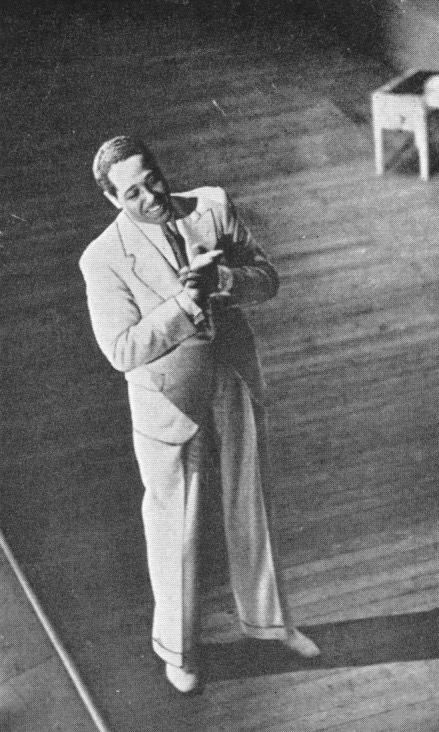
10. GOLDEN AGE
The years 1939-1944 are widely regarded to represent
the pinnacle of Duke Ellington’s artistic achievement, and there is much to
justify this claim. The majority of the
1940 orchestra—Sonny Greer, Fred Guy, Joe Nanton, Juan Tizol, Harry Carney,
Johnny Hodges, Barney Bigard and Otto Hardwicke—had been with Ellington for more
than a decade. Taken together as an
ensemble, as section players, and as individual soloists, this superb musical
aggregation represented the epitome of American musical talent. As the vehicle for Ellington’s musical
imagination, they had long been a formidable unit.

Changes in personnel over the intervening years had
been slight. Trombonist Lawrence Brown
was added in 1932; Rex Stewart, a renowned cornetist from Henderson’s band,
replaced Freddie Jenkins in 1934, while Wallace Jones took Arthur Whetsol’s
position as lead trumpet in 1937. The
most notable additions were Ben Webster (in the orchestra from l940 until 1943,
and again from 1948 to 1949), who, as the fifth member of the reed section,
established a tenor saxophone tradition in the Ellington orchestra; and bassist
Jimmie Blanton (from late 1939 until 1941, shortly before his death at the age
of twenty-one), who revolutionized the use of his instrument in jazz.
Perhaps most significantly, it was in 1939 that
Ellington began his association with Billy Strayhorn, whom he later described
as “my right arm, my left arm, all the eyes in the back of my head, my
brainwaves in his head, and his in mine.”

Strayhorn was first engaged by Ellington as a writer
of lyrics, but after the orchestra’s return from its second European tour, in
the summer of 1939, he began to exhibit a prodigious talent for arranging and
composition, both alone and in collaboration with Ellington. Particularly during the years 1940 and 1941,
when ASCAP material was banned from the airwaves, Ellington was forced to rely
heavily on the work of Strayhorn (“Take the ‘A’ Train,” “Chelsea Bridge,” “Day
Dream,” etc.), along with that of Tizol and Mercer Ellington (“Things Ain’t
What They Used to Be”). Until
Strayhorn’s death, nearly thirty years later, the emotional affinity
between the two men was the basis of
perhaps the most remarkable partnership in jazz, one which had a large impact
on the range and scope of the Ellington orchestra.
Nineteen-forty was also the year of a major defection
from the Ellington organization, that of trumpeter Cootie Williams, who left to
join Benny Goodman’s orchestra late in that year. In a 1967 interview, Williams explained:
I didn’t just jump up and
leave—I wouldn’t do that. Duke knew
about it and helped set everything up. He
got me more money, and I told him I’d be back in one year’s time. If Duke didn’t want it to be know like it
was, it wasn’t my place to tell. But
that Goodman band—I loved it.
When, as agreed, Williams contacted Ellington in a
year’s time; Ellington advised him to take advantage of his name-exposure with
Goodman and to front his own band (which Williams did successfully for many
years. He finally returned to the Duke
Ellington Orchestra in 1962.) In the
meantime, in November, 1940, Ellington hired the uniquely talented musician and
showman Ray Nance from Chicago whose first night playing with the Ellington
band was on November 7, in Fargo, North Dakota (which coincidentally was a
performance recorded by a pair of amateur enthusiasts. Until its official release decades later, the
Fargo recording became something like the Holy Grail of jazz.)
 |
| Cootie Williams |
Judging by its recorded output on the Victor label
from 1940 until the recording ban enforced by the American Federation of
Musicians in mid-1942, the Ellington orchestra of the early war years
represented an artistic standard unprecedented and unsurpassed in all American
music. For the same period, however,
accounts of Ellington’s financial success vary somewhat. One of them, citing Ellington’s habit of long
delays in providing lead sheets of his compositions to Robbins, with the
consequent drop of sheet-music royalties, estimates the band’s take at $2,500 a
week, with an annual box-office gross of around $200,000, netting Ellington no
more than $30,000 a year, which he quickly spent. Of course, when these figures are set against
the earnings of the most popular white orchestras of the period (Kay Kyser
grossed some $1,200,000, while Glenn Miller made in the neighborhood of
$1,000,000), they show how far Ellington was from the top echelons of show
business.
 |
| Ray Nance and Duke Ellington |
Mercer Ellington estimates the orchestra’s 1940 gross
much higher, at more than $1,000,000, but confirms the financial gap between it
and the earnings of popular white orchestras:
Bands like Vaughan
Monroe’s were probably grossing five times as much, and who knows or can say
what was happening with Benny Goodman? A
tremendous amount of money was being made by the big bands, and despite Pop’s
memory of the 1929 crash and other fiascoes, it looked as though everything was
on the up and up. Everything was going
wonderfully in the early ‘forties, so why worry about tomorrow?
Richard Boyer, who
authored a series of in-depth articles on Ellington (“The Hot Bach”)
for The New Yorker in 1944, provided a more detailed picture of the
band’s income and expenses. According to
Boyer, the band earned nearly $1,000,000 over its twenty-year period of
existence, of which half came from royalties paid on its sale of twenty million
records, and another fourth from sheet-music royalties. For one-night engagements, Ellington
reportedly collected between $1,250 and $2,000, as much as $10,000 a week, “but
the band’s payroll and expenses are so heavy that he is fortunate if he breaks
even on the road. Sidemen in the
orchestra received between $125 and $185 a week, plus expenses; Ellington himself drew $600 a week, $250 from current
receipts and the remainder in the form of an allowance from an auditor (William
Mittler, a white man) who handled his financial affairs. Much of Ellington’s financial bind, wrote
Boyer, was caused by his apparent lack of concern about money: “He spends money
lavishly, supports a good many hangers-on, lends money frequently, gets it back
infrequently, and is usually broke when pay day rolls around.”
In 1939, according to the same source, Ellington took
in $160,000, but the band was able only to break even. In 1940 he grossed $185,000, but the payroll
increased from $25,000 to $30,000. In
1941 he took in only $135,000 and ended up with a loss of $1,500. The following year saw an increase in the
band’s gross to $210,000, but Ellington netted only $4,000. During a six-month engagement at New York’s
Hurricane Club in 1943, Ellington lost $18,000, “but he figured it was a good
investment because of the Broadway address and the free radio time and
publicity.”
Whatever his financial disadvantages may have been, immediately
upon signing with the William Morris Agency Ellington continued to be booked in
prestige locations, like the Ritz Carlton Roof in Boston and Chicago’s Hotel
Sherman. During the rather brief
existence of the Morris Agency’s band department, and later with Joe Glaser’s
Associated Booking Corporation, Ellington was managed by Cress Courtney, who
proved as resourceful as Ned Williams had been in boosting Ellington as a prestige
performer and in preserving the dignity of his name. William Morris, Jr., came to take a special
interest in this aspect of his career, and his efforts paved the way for the
orchestra’s 1943 debut at Carnegie Hall.
Buoyed by the optimism and enthusiasm engendered by
his new business arrangement, Ellington set out in 1941 to realize one of his
fondest ambitions, the writing of a successful Broadway musical. His efforts resulted in the score for Jump
for Joy, which opened at the Mayan Theatre in Culver City, California, in
June, 1941. The show, billed as a
“Sun-Tanned Revue-sical,” had as its major theme the demolition of racial
stereotypes. As Ellington explained,
In 1941 a team of scholarly Hollywood
writers decided to attempt to correct the race situation in the U.S.A. through
a form of theatrical propaganda. This
culminated in meetings at which the decision was made to do Jump for Joy,
a show that would take Uncle Tom out of the theatre, eliminate the stereotyped
image that had been exploited by Hollywood and Broadway, and say things that
would make the audience think. The
original script had Uncle Tom on his death bed with all his children dancing
around him singing, “He lived to a ripe old age. Let him go, God bless him!” There was a Hollywood producer on one side of
the bed and a Broadway producer on the other side, and both were trying to keep
him alive by injecting adrenalin into his arms!
For its time, such a production was a venture of the
most radical sort imaginable. The show’s
cast and financial backers, in addition to being “top-bracket film people,”
included a number of figures who were prominent in the Hollywood left, chiefly
the Communist Party. Since most whites
in those days who were at all involved in the political defense of Black rights
were considered radicals ipso facto, it is not surprising that Ellington
would have been associated with Communists in a project as outspoken as Jump
for Joy. Ellington’s sporadic involvement with the radical left had begun
nearly a decade earlier, and in the 1940s this relationship would culminate in
the most overtly political phase of his career.
By the end of that decade scores of his associates would wind up on the
show-business blacklist and before Congressional inquisitors.
Jump for Joy,
of course, was theatrical dynamite. Its
audience included “the most celebrated Hollywoodians, middle class ofays, the
sweet-and-low, scuffling-type Negroes, and dicty Negroes as well… The Negroes always left proudly, with their
chests sticking out.” Naturally, there were some who were not
pleased; Mercer Ellington recalled that there were “something like five ‘or six
bomb threats from people who threatened to do something to or harm people in
the show.” As a result, the show’s material came to be a
sort of compromise, as writers and members of the cast revised it nightly. One of the numbers dropped was the opening of
the second act, with the intriguing title “I’ve Got a Passport from Georgia
(and I’m Going to the U.S.A.)” The
attempt was made to accommodate the sensibilities and inhibitions of all who
were involved in the production, as Ellington explained, “Anyone who attended
those backstage meetings for twelve weeks got a full college education in social
significance.”
The importance of Jump for Joy was summarized
by Avanelle Lewis Harris, a veteran of the theater and a member of the show’s
original cast:
The most exciting
experience of my life in the theatre was the opportunity to be a member of the
cast in the musical Jump for Joy. I did not know how far ahead of its time it
was until I read the script. It was the
first legitimate show to be created and produced on the West Coast. The importance of its message caused a wave
of enthusiasm throughout the cast, which was well-aware of its controversial
impact. Everything, every setting, every
note of music, every lyric, meant something.
All the sketches had a message for the world. Tragedy was that the world was not ready for Jump
for Joy.
How I remember the
opening— “The Sun-Tanned Tenth of the nation!”
And the finale of the first act was “Uncle Tom’s Cabin Is a Drive-in
Now”:
There used to be a
chicken shack in Caroline
But now they’ve moved it
up to Hollywood and Vine;
They paid off the
mortgage—nobody knows how—
And Uncle Tom’s Cabin is
a drive-in now”
Jump for Joy,
playing to standing-room-only crowds, was a great local success, yet it never
reached Broadway, as its producers had hoped; the show closed after only three
months in Los Angeles (A 1958 production, with revamped songs and starring
Barbara McNair, was staged unsuccessfully in Miami Beach).
These
facts are hard to reconcile in the light of frequent claims over the years that
the show was “too advanced” and that the public was “not ready” for what it had
to say. The production’s popularity
gives much credibility to Mercer Ellington’s assertion that Jump for Joy
was “scuttled from the inside”:
There were lines at the
box office when the show closed down because of panic in the company. The different people who contributed their
services to the show all owned a part of it and were to be paid off at a later
date. Suddenly the musicians’ union
demanded additional bonds to ensure payment of their people. The backers had their lawyers attach the box
office, so the flow of money that could have kept the show going was cut off
and everybody suffered.
In a sense, the American public generally was “not
ready” for such a message during the war years.
The tenor of the times indicates that African Americans were more than
ready to do away with their inferior social status. This was still the era of segregated blood
banks, on the battle-front and the home front as well. As Blacks were widely considered “loyalty”
risks, the government lost few opportunities to harass the Negro press and to
spread poisonous propaganda. These were
years of lynchings in the South and riots in the North and on military posts. White liberals largely abandoned the Black
cause, with predictions of civil war if federal troops were used to end
segregation.
Ellington, perhaps because he was always inclined to
couch his social criticism in the most palatable form (“I think a statement of
social protest in the theatre should be made without saying it, and this calls
for the real craftsman”), was not long discouraged. As he explained, “The feeling of
responsibility that Jump for Joy had aroused sustained itself, and one
day William Morris, Jr., said, “I want you to write a long work, and let’s do
it in Carnegie Hall.”
This opportunity was to be the fulfillment of
Ellington’s desire, expressed since the mid-1930s, to present a musical
panorama of the American Negro. The
five-part suite he had envisioned, tentatively titled Boola, never
materialized, although parts of his conception had appeared in the 1934 film
short, Symphony in Black, and in some of his shorter compositions, such
as “Ko-Ko.” With barely a month to
spare, Ellington began work in December, 1942, on the score of Black, Brown
and Beige, subtitled A Tone Parallel to the History of the American
Negro.
With the single exception of Benny Goodman’s 1938
concert, Ellington’s premiere on January 23, 1943, was the first genuine jazz performance
to play Carnegie Hall. The significance
of the occasion, of course, was to narrate the history of Black Americans; even
so, a charitable pretext was necessary to secure the hall: all proceeds were to
go to the Russian War Relief.
The concert was preceded by months of publicity,
particularly in the Negro press, which culminated in the declaration of “Duke
Ellington Week,” January 17 through January 23, the night of Ellington’s
premiere. The New York Age
reported on a flurry of Ellington broadcasts and record programs, and enthused
over the “complete cooperation of the entertainment business, including both
[Ellington’s] sepia and white brother musicians.” Carnegie Hall was “virtually sold out… with a
last-minute rush for the few seats which remain,” and the Age circulated
a rumor that Edward, the Duke of Windsor, whose acquaintance Ellington had made
in 1933, would be in attendance among the celebrities.
Previews
of the concert a week prior to the event contained spotty information. In Down Beat Helen Oakley stated
the title of Ellington's opus only as "A Tone Parallel," which she
calls "the latest and to date most significant work yet delivered from the
pen of the famed Negro composer.” Unlike
previous jazz performances at Carnegie Hall, Oakley continues, Duke Ellington's
will be "a serious program hailing the attention of Carnegie's customary
patrons." The article goes on to describe the movements
"Black," "Brown" and "Beige," apparently unaware
of the title of the suite as a whole. She describes the rest of the
program, singling out "Blue Belles of Harlem," an Ellington tune
written much earlier for the bandleader Paul Whiteman.
A
little more informed, Howard Taubman’s piece in the New York Times Magazine
took the form of an interview with Ellington at his Harlem apartment. "Ellington's most elaborate composition
is an opera, still unproduced, called "Boola"... He has taken some of
the music from this opera and turned it into a half-hour tone poem for his
band, and he will unveil it at Carnegie Hall. It is called 'Black, Brown
and Beige."
A
jointly-written article by Brian Priestley and Alan Cohen, "Black, Brown
and Beige,"
first published the year of Ellington’s death, is probably still the most
detailed and comprehensive examination of the suite ever undertaken. It
begins with the assertion that, of all Ellington's extended compositions, Black,
Brown & Beige was the most "symphonic," in the sense of
the traditions of the European masters:
Black, Brown & Beige is not only a work of
symphonic scale but, of all Ellington's extended compositions, the one most
profitably influenced by symphonic devices." "Black," in
three parts ("Work Song," "Come Sunday," "Light"),
represents the closely argued yet unresolved hypothesis typical of a
symphony. The central "Brown" movement begins as a series of
dances ("West Indian Dance" and "Emancipation Celebration")
and closes with "The Blues." "Beige continues the dance
motif with a waltz, but proceeds with a final regathering of Ellington's
material and ends with an exclamation point: the Black, Brown and Beige are
right in there with the red, white and blue.
The
authors then cite Barry Ulanov’s 1933 interview, mentioning a "negro
suite' in five parts, "from its source in the African jungle... [through]
the future for the fifth and last movement, probably a hundred years from now,
and give an apotheosis aiming to put the negro in a more comfortable place
among the people of the world and a return to something he lost when he became
a slave." This description "had much in it of the opera [Boola]
he had been preparing for an even longer period." They proceed to Ellington's remarkable film
short of 1935, Symphony in Black, whose four movements directly
forecast the themes to be used in Black, Brown & Beige.
Amid
all the hoopla preceding the Carnegie Hall event, what the public generally did
not know was that Ellington had prepared, along with his score, a full libretto
for Black, Brown and Beige, conceived as an opera after all. Professor Harvey Cohen’s research among the
Smithsonian Institute’s Ellington manuscript collections brought out for the
first time Ellington’s original intent. Cohen
laments:
There is a sadness and frustration expressed in the
unpublished scenario that [Ellington] never voiced in public. The
reception of the work would have definitely been altered had critics possessed
the document upon [Black, Brown and Beige's]
premiere. Perhaps the reason it never came out was that, by 1943,
Ellington had already witnessed the lack of financial support given to projects
that overtly (if humorously) challenge Jim Crow and celebrated little-known
African and African American history; ... in 1943, the script probably
would have aroused resistance, Ellington sought to avoid such reactions.
Ellington's
original plan, in fact, was the five-opera he'd had in mind for over a decade,
with a protagonist named Boola. The Brown and Beige scenario
necessarily underwent numerous drafts, some or all of which are filed at the
Smithsonian. The imagery in Ellington’s
original lyrics were highly revealing of his mindset in the midst of the Second
World War. Here, for example, is his
lyric for the spiritual theme, “Come Sunday”:
Came Sunday. With all the whites inside
The church, their less
fortunate brothers
Emerged from everywhere to congregate
Beneath a tree. Huddle there, they passed
The Word of God around in whispers...
When the whites inside lifted voices
In joyous song...
The Blacks outside would hum along,
Adding their own touches... weaving melodic,
Harmonic, rhythmic patterns.
Thus the spiritual was born.
Highly emotional worshipping of God
In SONG.
For
the portion of “Beige” subtitled "Emancipation Celebration,"
Ellington wrote,
"They had earned the right to finish out
Their sorry lives unworried and at ease...
What now? 'You must go... You're trespassing
here.'
'Get up and go!' But where?
... Nobody knows but Jesus...
'They set us free... but left us alone
To starve... to freeze... to die.
Truly
it was once more in Duke Ellington’s best interest to “say it without saying
it.
*
Many
years after the event, Ellington recalled,
The first night at Carnegie was the only time in my life
that I didn't have stage fright. I just didn't have time-- I couldn't
afford the luxury of being scared. Dr. Arthur Logan, an old friend and our
personal physician, was standing around backstage handing out pills to
everybody in the band. He even took one himself. He offered one to
me and I refused it. I wasn't nervous-- not at all. But I did walk
onstage without my music. Somebody signaled to me from the wings that
they had it-- but I didn't need it anyway; I remembered it all!
Black, Brown and Beige received praise
from Henry Simon in PM, Irving Kolodin, Billboard and Variety
(“ELLINGTON, AT B.O. AND MUSICALLY, NIFTILY IN GROOVE AT CARNEGIE HALL
CONCERT”). The jazz press, Down Beat
and Metronome, was also sympathetic, but here too there was some
controversy, centered chiefly around a salvo fired by John Hammond in the People’s
Voice. In an article titled "Is the Duke Deserting Jazz"? the critic confessed having discovered “some
penetrating wit and marvelous tunes” in Black, Brown and Beige, but
concluded that “Duke has neither the training nor the ability to weave them
together in to a cohesive whole.”
The
May 1943 issue of Jazz carried both sides of the debate, beginning
with Hammond, who wrote:
In the first half of his career as a bandleader, Ellington
was content to be leader of the finest dance unit ever produced... Duke
had a tremendous melodic gift, unequalled by any other popular composer of the
day, and his band had a distinctive style that set it apart from any other in
the land.
In 1933 he finally took his band to England and started a
new phase in his career." Hammond argues that the lavish praise
heaped upon Ellington at that time went to his head and fueled his ambition to
write "serious" music.
Leonard
Feather’s rebuttal took the form of a personal attack on Hammond: "I think it is a dirty rotten,
lowdown no-good shame that somebody like John Hammond, who has done so much to
eliminate race prejudice in music, should be so completely befuddled by
personal prejudices himself." These "prejudices," Feather
maintained, were mostly motivated by Hammond's inability to run Ellington's
band and career, as he had Billie Holiday's, Count Basie's, and others.
"Duke thought he knew better than Hammond how to run the Ellington
band." Ellington and his music, Feather concluded, "will be
remembered longer than the puny attempts to dictate to him or belittle him when
the attempts at dictatorship fail.”
Under the presidency of James C. Petrillo, the union
declared a long strike against the entire recording industry; the only studio
recordings permitted between August 1942 and November 1944 were transcriptions
recorded for the radio networks only, and V-Discs for the Armed Forces.

At the orchestra’s second Carnegie Hall concert
appearance in December, Ellington presented New World A-Comin’, a
twelve-minute concerto for piano and orchestra.
Composed after the band’s Hurricane Club engagement, during a four-week
run at the Capitol Theater with Lena Horne, the piece was an extension of the
thematic material which had informed Black, Brown and Beige and was
analogous to the final section of the unfinished Boolah, which purported
to speculate upon the future of the Black race.
Inspired by and titled after a book by Roy Ottley, which anticipated an
improvement in the Negro’s lot after World War II: “In spite of selfish
interests,” the book concluded, “a new world is a-coming with the sweep and
fury of the Resurrection.” Ellington
visualized this new world “as a place where there would be no war, no greed, no
categorization, no nonbelievers, where love was unconditional, and no pronoun was good enough for God.”
Under the management of Cress Courtney, the six months
of free airtime afforded by the Hurricane Club engagement had helped preserve
Ellington’s preeminent position in the entertainment world, increasing the
orchestra’s price nearly four times to $5,000, or $4,000 plus a sixty per cent
privilege. Nevertheless, because its
members were Black, the Duke Ellington Orchestra could not obtain a regular
radio sponsor. According to one
observer, “Duke thought that winning the war would change this and much more. When he was working at that time on a
composition called New World A-Coming, he liked to repeat the title and then
say, ‘And I mean it.’” In spite of its much shorter length, this
new composition was denounced by the critics just as vehemently as its
predecessor had been (it did manage to stay in the band’s repertoire and was
recorded as late as 1970, with the Cincinnati Orchestra, conducted by Erich
Kunzel.)
The entrance of Ellington into the concert field came
as the result, not only of social pressure emanating from the music
establishment, but of economic necessity as well. During the war years, to be sure, he appeared
before the public as a rather gaudy embodiment of Black success: “ He has forty-five suits, and more than a
thousand ties, the latter collected in forty-seven states of the Union and
seven European countries, and his shoes, hats, shirts, and even his toilet
water are all custom-made. His 1,100
records had sold some twenty million copies, and he had composed 1,200
compositions, many of which had been praised by composers as esteemed as
Stokowski, Grainger, Stravinsky, and Milhaud. Around this time, too, Ellington began to
spurn the label “jazz,” referring to his music first as “Negro folk music,” and
in later years as “the American Idiom, or the Music of Freedom of Expression.”
As an astute businessman, Ellington undoubtedly was
quick to realize that, with the onset of war, the appearances of large jazz
ensembles in dancehalls, nightclubs and theaters were beginning to diminish,
that the days of the “big band era” were numbered. Critic Stanley Dance, his friend and
confidante, wrote:
The move to the concert
hall and the changes that ensued were inevitable. They grew out of the practices of the
Thirties. Bands and ballrooms were in
big trouble because of World War II, and concerts offered the possibility of
welcome new venues and, indeed, an artistic stimulus…
Ellington, undoubtedly
the wisest and most intelligent person in the business, had always been quick
to size up the potential in a situation—and to act. In retrospect, one can see that his timing
was perfect in 1943. All the writing
that had been done about jazz in books and magazines—not to mention the
publicity hopes—along with the extended public exposure to it on radio, had
created a big and enthusiastic audience, one that was often idolatrous, but not
always noticeably hip. The extended
works had prestige value, an air of ambition and serious endeavor that
three-minute masterpieces with offbeat titles did not have.
For seven years Ellington presented his
“social significance thrusts” to audiences at Carnegie Hall and Each year he
would produce a new extended work, often based upon a racial theme: in 1946 came the Deep South Suite, the
Liberian Suite in 1947, and Harlem in 1950. Other extended works from the same period
were lighter exercises designed to satisfy the musical sophisticates in his audience: Perfume Suite (1944), A Tonal Group
(1946), and The Tattooed Bride (1948).
Before
the war’s end, a particularly astute profile of Ellington, wide-ranging and
perceptive, was published by Richard O. Boyer.
Titled "The Hot Bach," the article originally appeared as an
extensive, three-part piece in The New Yorker in the summer of 1944.
Part I
opens with an evaluation of Ellington in the context of the birth of jazz,
whose history was largely within his own career. "Music of the
Spheres" v. New Orleans brothel "entertainment." Of Ellington himself, Boyer observes "Ellington
has, like most entertainers, a stage self and a real self." "As the
spotlight picks him out of the gloom, the audience sees a wide, irrepressible
grin but, when the light moves away, Ellington's face instantly sags into
immobility."
Boyer
then discusses many themes Ellington would repeat throughout his career, such
as wasting time arguing with a band member vs. using that time writing a hit
song. Ellington's religiosity, his interest in Black history, and his
eating habits, coming up with Joe Nanton’s priceless observation:
"He's a genius, all right, but Jesus, how he eats!"
The
article follows the band through a Midwest tour by train; attends a card game
among the band members, the differing roles of Ellington and Strayhorn.
He describes a typical one-nighter: “In general, or so its members like to
think, the more exhausted the Ellington band is, the better it plays.
Ordinarily, the tempo at the beginning of a dance is rather slow; both players
and dancers have to warm up to their interdependent climax. By midnight,
both are in their stride.” Boyer gives
vivid, detailed descriptions of the band members onstage.
Part
II
begins with observations on Ellington's calm, seemingly imperturbable demeanor.
Boyer proceeds to explain the cooperative nature of the band in rehearsals and
its process of creation, a dialogue with its leader at the piano. When
disagreement crops up among the members, Duke, whom European music critics
have called the American Bach, will resolve the debate by sitting down at his
piano, perhaps taking something from each suggestion, perhaps modifying and
reconciling the ideas of the two men, but always putting the Ellington stamp on
the music before passing it on to the next part of the work in progress.
Duke sometimes quotes Bach. "As Bach says," he may remark,
speaking about piano playing, 'If you ain't got a left hand, you ain't worth a
hoot in hell.'" Boyer recounts the
Ellington band's complete itinerary for 1942, from one-night dance or theater
engagements to weeks-long residencies in big cities, a very long list of venues
indeed. Ellington himself is observed in a host of situations, sometimes
discussing the origin of some of his famous tunes.
Part
III begins
by comparing the dignity of Ellington and his orchestra to the stereotyped
image of Buddy Bolden's "attractive degeneracy" and the legend of Bix
Beiderbecke drinking himself to an early death. When asked about it, Duke
replied, concerning the sprees of his youth, "I should have kept a
diary." Of critics who compare his
achievements in "columns of rococo prose" to the glories of ancient
Greece and Rome, Ellington responds, "It seems to me such talk stinks up
the place." Boyer himself observes
that Black musicians look askance at jazz critics and the white world
generally, viewing them as "an inexplicable order which simultaneously
gives them adoration and Jim Crow."
Boyer relates Ellington's knowledge of Black history, but publicly he
"usually sets his beige-colored face in a grin as wide as possible,"
preferring to express his ideas musically. Ellington claims that the four
beats to the bar in jazz "has been beaten into the Negro race by three
centuries of oppression." "The
four beats to the bar in jazz are also found, he maintains in verse, in the
Negro pulse. Duke doesn't like to show people his poetry. 'You can say anything you like
on the trombone, but you gotta be careful with words,' he explains.
Boyer
calculates that Duke Ellington made nearly a million dollars since beginning
his career in New York but has spent it as he made it. To date, he had
sold twenty million records and earned half a million in record royalties
alone. In recent years, the band had played mostly one-night stands,
dances, and concerts. The band makes between $1,250 and $2,000 a night,
depending on attendance. They gross as much as $10,000 a week, but
payroll and travel expenses are heavy. The sideman receive between $125 and
$185 a week, plus travel expenses. Ellington himself draws $600 a week,
$250 of which is a spending allowance provided by William Mittler, the band's
auditor.
Says
Boyer, "[Ellington] spends money lavishly, supports a good many
hangers-on, lends money freely, gets it back infrequently, and is usually broke
when the weekly payday rolls around. " The band's overhead expenses have
increased from year to year: in 1939 the band earned $160,000 only to
break even. In 1942 they grossed $210,000 but netted only $4,000. The band's 1943-44 Hurricane Club six-month
engagement lost $18,000, but Ellington "considered it a good investment
because of the Broadway address and the free radio time and publicity."
Duke
Ellington's apartment was located at 935 St. Nicholas Avenue in Harlem.
His "gold-and-blue rugs and tapestries from Sweden are modern.
Boyer's final comments concern Ellington's new concert creation, New
World A-Coming: "And I mean it," says Ellington.
His ambition to serve as a spokesman for
Black aspirations was well illustrated in the 1943 announcement of his
collaboration with lyricist Otto Harbach on a ditty, unfortunately lost to
posterity, titled “Did You Mean It, Mr. Lincoln?” Publisher Jack Robbins said that the song
would “go a long way in developing racial awareness.” At the same time, however, Ellington did not
consider it prudent to risk his career by voicing his ideas other than
musically. Richard Boyer wrote of this
private conflict:
Duke sometimes thinks that it is good
business to conceal his interest in American Negro history. He doubts that it adds to his popularity in
Arkansas, say, to have it known that in books he has read about Negro slave
revolts he has heavily underlined paragraphs about the exploits of Nat Turner
and Denmark Vesey. In public he usually
sets his beige-colored face in a grin as wide as possible…
Ellington was aware of the explosiveness
of such sentiments in the 1940s. His
prestigious concert appearances were still rare occasions, and between them, at
one-night engagements across the country, he was still beset by the usual
indignities afflicting Black musicians. One
such incident took place late in 1943, when it was arranged for the orchestra
to give a recital at Camp Robert Smalls, a segregated portion of the Great
Lakes Naval Training Center. A great
deal of friction existed between Black sailors and their white officers, who,
one sailor remembers, habitually referred to the Blacks as “you people.” Additional resentment was generated when,
apparently at whim, the commanding staff moved Ellington’s performance to a
nearby white base.
Although the incident, because of wartime
secrecy, was not widely known, it came to the attention of a number of Black
leaders. However sympathetic to
Ellington they may have been, they chose not to intervene, as a letter to
Ellington from Claude Barnett of the Associated Negro Press makes clear:
When I talked with you the other day, I
did not realize how much of an imbroglio the Camp Robert Smalls engagement had
caused. I had no more than hung up
before Variety
called me.
This
note is merely to say that I am not particularly involved. If I could do a good turn for the colored
boys out there and give more of them a chance to see and hear you and other
colored bands, I was willing but I do not wish to get into any controversy over
matters which do not concern me.
It does not appear to me that Commander
Peabody has been as considerate of those who sought to work with him as he
might have been but that is his problem and perhaps disadvantage.
What I wanted you to know is that I would
not presume to interfere in your affairs.
Hope it all works out smoothly.
Another incident, cited in Boyer’s article
the following year, illustrates graphically the extremes suffered by
Ellington’s musicians, their Carnegie Hall honors notwithstanding. On the second day of an engagement in St.
Louis, during a break between sets the men found it impossible to order lunch
anywhere near the theater. As soon as
they went back onstage, still hungry,
the curtain rose, and from the white
audience out front there came a burst of applause. The crowd cheered, whistled, and stamped its
feet. As the curtain was going up, the dejection on the faces of the players
vanished, and as swiftly as an electric light is switched on, it was replaced
by a look of joy. The music blared, Duke
smiled, threw back his head, and shouted “Ah-h-h!” Rex Stewart took off on a solo that was
greeted with fervor, and as he bowed, the musician next to him muttered out of
the side of his mouth, “Bend, you hungry fathead! Bend!”
Everything was flash and brightness until the curtain came down. Then the joy was switched off and there was
just a group of angry, hungry Negroes arguing their right to food.
“Can’t we eat in our own
country?” Rex Stewart said.
“And my son is in the
army!” another man said.
“Are we prisoners or
something?” Harry Carney asked…
Band manager Jack Boyd
was finally able to arrange for food to be sent in. After the show
Boyd was in a saloon overlooking
the stage door when a man in the band came out and got into a taxi.
“Did you see that?” asked
a woman on a stool at the bar.
“See what?” Boyd asked.
“See that nigra get in
that cab?”
“Well, he’s a pretty nice
fellow. He’s a member of the Ellington
band. Some people think that he’s a very
great artist.”
“A very great
artist? Well, I don’t know what you
think, but I always say that the worst white man is better than the best
nigra.”
Still
further, concerning "Beige," the final movement of Black,
Brown and Beige:
"The opening themes of the third movement reflect the
supposed-to-be-Negro-- the unbridled, noisy confusion of the Harlem cabaret
which must have plenty of 'atmosphere' if it is to live up to the tourist's
expectation. But-- there are, by numerical count, more churches than
cabarets in Harlem, there are more well-educated and ambitious Negroes than
wastrels. And my fantasy gradually changes its character to introduce the
Negro as he is-- part of America, with the hopes and dreams and love of freedom
that have made America for all of us."
*
Early
in 1947, Ellington was invited to share his views on a variety of subjects by
the music journal Etude, beginning with his definition of luck:. “I
was lucky, indeed, to begin when I did. But perhaps I should define my
notion of luck; to me it means being at the right place at the right time and
doing the right thing before the right people. If all four ‘rights’ are
in good order, you may count yourself lucky.”
Further
along, Ellington addressed the question, “What, exactly, is jazz?” Here he
embraces the term: “Just as the classic form represents adherence to a
structural standard, just as romantic music represents a rebellion against
fixed forms in favor of more personal utterance, so jazz continues the pattern
of barrier-breaking and emerges as the freest musical expression we have yet
seen. To me, then, jazz means simply freedom of musical speech!”
Ellington,
moreover, insists on the essential American-ness of jazz. “We say that
music is typically jazz, or typically American, if it follows no [particular
ethnic] pattern at all! Even the Negroid element in jazz turns out to be
less African than American… The pure African beat of rhythm and line of
melody have become absorbed in its American environment.”
*
The
years following the Second World War marked a sharp change in jazz and popular
music generally; the so-called big band era, largely for economic reasons, came
skidding to a close: by 1950 even Count
Basie’s band was reduced to an octet, while most others dissolved entirely in
favor of the small groupings of modern jazz.
Largely because of his accumulated songwriting royalties, Duke Ellington
was the exception, but even he faced some hard times in the decade to come.
Duke Ellington, Down Beat Silver
Jubilee, 1952 (TDER, 266)