Search This Blog

Monday, March 29, 2021

Hangin' out with The Four Freshmen: Oshkosh 1991

NB:  I wrote this piece in 1993 for esq, but I'm not sure whether they published such a hefty memoir.  Now it belongs to the world.


"IT NEVER OCCURRED TO ME"

It seems I always do things bass-ackwards.  

 Beach Boys Concert album in 1964, probably the first record album I ever bought, contained the standout track "Graduation Day."  While introducing it, Mike Love explained the song was originally performed by the The Four Freshmen, "a group very inspirational to our careers, because they influenced Brian Wilson and his writing."  Mike, seldom a master of understatement, was as accurate as he was gracious, but I didn't take his hint for more than twenty-five years, when I finally began picking up Freshmen records.  The moment I heard them, I came to the conclusion that Dick Dale and Phil Spector did indeed shape Brian's music in important ways, but at the root of it all was a vocal and instrumental jazz quartet originally from small-town Indiana, of all places.  The Freshmen could hardly have imagined their sound translated into southern California teen music, but the truly odd fact remains that the basic sound of The Beach Boys proceeds less from rock 'n' roll than it does from jazz, especially big-band sectional scoring, filtered through the vocal sound of the Four Freshmen.

On one occasion, when asked about his earliest influences, Brian explained it this way:

My mother just pointed out a record on the radio one day ["Day by Day"] and I liked the sound of what I heard enough that I wanted to hear more, so I had to go to a record store and sample some records by the Freshmen to get satisfied.  It was satisfying, but it left me really wanting more for some reason.  It's just a sound, that's all it was.

Brian wore out the grooves of Four Freshmen records as he progressed from admiration to emulation.  With his father he visited the group backstage at a performance at the Cocoanut Grove, one of his earliest thrills, and soon began dropping by their office in Hollywood to borrow copies of their vocal charts.  Before long Brian was using the Freshmen's sound in his own way.

The Cocoanut Grove

Brian modeled the voices and arrangements for his group after the Freshmen's lineup, down to the timbre of each individual voice.  He himself adopted the high tenor lead of Bob Flanigan, while Mike's bass parts were inspired by the singing (at that time) of Ken Albers.  The crucial middle parts assigned to Carl Wilson and Al Jardine mirrored the Freshmen parts executed by brothers Don and Ross Barbour, who along with cousin Flanigan and friend Hal Kratzch, founded the Four Freshmen when they actually were freshmen at Butler University's Jordan Conservatory of Music in Indianapolis in 1948.


"THE DAY ISN'T LONG ENOUGH"

The American Legion hall, an old, white-sided building that looked the part, sat on the shores of Lake Winnebago.  Inside, the tables were lined up in long rows beneath a banner welcoming The Four Freshmen.  Surely The Beach Boys were never feted in a place like this.  Most of the fans were already queued up for beers at a cash bar in an adjoining room.

I found a stool, ordered a bottle of Stroh's, and began eavesdropping on a couple of old guys.  "Rosemary Clooney... The Pied Pipers... Anita O'Day... Frank Sinatra..."  They were not what I'd call hard-core jazz people, who by and large prefer instrumental music, whether arranged or improvised.  Four Freshmen fans seem to occupy an area of the market between jazz and pop, as those terms were understood forty years ago.  The defining trends in jazz proper do not greatly interest them.

A half hour later I was standing in the dinner line, where John and Dolores introduced me to Nikki Gary, the manager of The Four Freshmen, Bill Comstock, and finally the man himself, Bob Flanigan, who seemed in a very convivial mood.  He invited me to interview each Freshman after dinner.  I chose a table out of the way and readied a cassette.


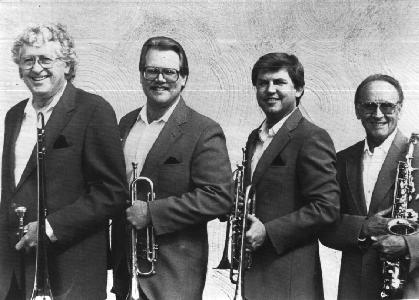
L to R:  Bob Flanigan, Mike Beisner, Greg Stegeman, Autie Goodman


AUTIE GOODMAN, now a fourteen-year veteran of the Freshmen, was the first to drop by.  He came to the group after a ten-year career with the Modernaires vocal quintet and work with the bands of Ray Eberle and Tex Beneke.  I asked Autie if the admiration for the Freshmen by The Beach Boys was mutual:

"I have two sons who were brought up in that era.  I hardly listen to anything but Nat Cole and jazz things.  I don't listen to any contemporary things at all.  I appreciate what they do, but i'm not interested in it because I was brought up in the era of jazz.and Charlie Parker and Dizzy Gillespie.

"I think the Beach Boys got their start by listening to Bob and the group.  They got their idea, and they put their own kind of modernization to it.  I think the Freshmen are the reason The Beach Boys got the way they are.  They put our sound to their style of music, and I think it's a marvelous tribute to Bob and the guys when they first started.  I wasn't with them then, but it's a tribute to them that they could be listened to and be copied by a contemporary group.  Also, Tony Butala of The Lettermen said they started out singing like the Freshmen before they got to be The Lettermen.   So a lot of contemporary people have adapted our style of singing to their own style, and it's a great tribute to the group.

"Bob used to do a put-on of "Surfer Girl" just to show that he could do it, but we've never done Beach Boys songs seriously.  We have to play to our fans, and besides it would be silly.  It would just sound like us doing their songs.  But if they've got something we could do, we sure would do it.  I'm sure Bob would like to do it."

According to Autie, the current Four Freshmen arrangements of "April in Paris" and "Li'l Darlin'" were taken from The Modernaires' book.  Presently Mike Beisner does nearly all the new arrangements for the Freshmen.  "I'm strictly a jazz musician.  I don't write any music.  I just sing it and play jazz saxophone."

GREG STEGEMAN looks to be going on twenty-eight, though he is actually forty and has had a long career in music since his mother gave him his first cornet.  Greg's discovery of The Four Freshmen came was when he was fifteen, and within a few years he acquired all their record albums.  A long stretch and many jobs later, he finally joined the group in August, 1989, ably filling in for the absent multi -instrumentalist Mike Beisner.

We began talking about Greg's skills as an arranger:

"I'm just starting to write for the group.  I've written in that style in the past, but the Four Freshmen library is so vast, and Mike is such an outstanding writer, that it's tough to squeeze one of my things in.  For a while we were doing my arrangement of "My One and Only Love," and "The Meaning of the Blues" is another thing I've brought into the group."

Greg agreed with me that the secret of Four Freshmen harmony lies in its inner voicing.  "Some day we'd like to record just the inner parts to see how they move.  It's all meant to create one sound.  Ideally, not one particular part is supposed to stick out.  The absence of vibrato allows the chords to really lock in."

Is Greg a Brian Wilson fan?  "I sure am.  In fact, given my age, when I was growing up The Beach Boys were the guys on the radio.  I had no idea who The Four Freshmen were.  That [was] something my parents had in their collection.  And then I realized that what I liked about The Beach Boys was their harmony, and indirectly they led me to the Freshmen.  In fact, on one of the early Beach Boys albums (Little Deuce Coupe) they did "A Young Man Is Gone," which was "Their Hearts Were Full of Spring" with different lyrics, as a tune about James Dean.  That knocked me out more than anything else.  That was my favorite Beach Boys song.  After I realized that was a Freshmen arrangement, the I knew I'd found my sound.  My parents had the original 5 Trombones album, and after that it was all over."  Greg also dug the Beach Boys' a cappella  on "The Lord's Prayer."


BOB FLANIGAN said he actually recalls meeting the young Brian Wilson.  "He was just a very young man with his family, and I wasn't really aware of who I was talking to--  Well, I was, but I didn't know what he would become.  Brian was the catalyst for that group.  He did the writing, the lead singing, and he was, for my money, the most important part of The Beach Boys in the early days.  It's just a shame that things went in the wrong direction for him for a period of time, because he's a very, very talented man, and the group has done some awfully good things.

"Of all the groups throughout the world that have copied The Four Freshmen, The Beach Boys are one of the very few who, when they do something of ours, always give us credit.  They say, 'This is something-- "Graduation Day," or whatever it might be-- 'This was recorded by The Four Freshmen.'  Which isn't necessary, but I think it's very nice."

Flanigan was recently honored by his hometown, Greencastle, Indiana.  It was a short trip from home to the Jordan College of Music in Indianapolis, where the Freshmen spent their formative years in 1948 and '49.  "When we first started singing, we had no arrangements.  We took each chord, and we harmonized it, the four of us, by ear and then remembered what we had done.  We listened to The Mel-Tones, a group that Mel Tormé had with Artie Shaw, and also The Pastels, who were with the Stan Kenton band.  They influenced us a lot.  But those early tunes were all done individually.  A guy would say, 'Let me try this part.'  That would work, and then someone else would say, 'I'll try this,' and so on.  We'd put those things together.

"We'd sound that way because we were always very influenced by the Stan Kenton band, and as we progressed musically we became even more so.  We always wanted to sound as much like the Kenton trombone section as you could sound, vocally.  Without Stan, in many ways, we wouldn't have lasted very long.  A lot of people think of us as like a sax section or a trumpet section or a trombone section.  Because we were all musicians, and everybody that's been in the group is a musician first and a singer second, we think like a section rather than a singing group.  That's one big difference between us and most of the groups."

Though The Four Freshmen started as a musical cooperative without a single arranging genius, Dick Reynolds stepped into the picture in 1951, while he was a trombonist-arranger with the Ray Anthony band in Hollywood.  "We were working in Jerry Wald's Studio Club.  The Anthony band was playing at the Hollywood Palladium, which was just half a block away, and guys would come in and have a drink.  We met Dick and became friends, but there was no thought of his writing for us at the time.  Then in 1955 we got the opportunity to do a song, "How Can I Tell Her," in a movie called Lucy Gallant.  Lee Gillette, our boss at Capitol, said, "You guys remember Dick Reynolds?  He's freelancing now in New York, and I think he's the guy that should write this arrangement.  So Dick came out to California and wrote the thing, we recorded it, and that was our first experience with Dick as an arranger.

"The association lasted until his death a couple of years ago.  In the beginning, Dick was not one of the big names in th business, although he was a great craftsman.  He did arrange many fine things for the Anthony band, like "Chattanooga Choo Choo," but nobody knew who he was.  When he started writing for us, we became his claim to fame.  Then he wrote for Roy Clark and The Beach Boys.  He wrote for everybody, including Lawrence Welk.  He could write anything, from charts for Welk to charts for the Kenton band.

"Over the years we've used a lot of different arrangers:  Dick Reynolds, Pete Rugolo, Nelson Riddle,  Billy May.  But by that time, we had established what The Four Freshmen were supposed to sound like.  And if you get an arranger of that caliber, they know what we're supposed to sound like.  There's no problem, go straight ahead.  They each add their own personal touch to it, which makes it still The Four Freshmen, but The Four Freshmen presented in many different. ways.


MIKE BEISNER is the youngest Freshman, though now a ten-year veteran with the group, discounting a hiatus in 1989-'90.   At the age of sixteen Mike filled a trumpet chair in Stan Kenton's orchestra, and by 1981, when Flanigan recruited him, he had mastered nearly the entire range of brass instruments.  When we started talking, Mike was discussing makes and models of flugelhorns and trombones with an admirer standing nearby.  I commented that he had contributed many arrangements to the current book, both vocal and instrumental.

"Oh yeah.  "April in Paris" is one of my charts, and the Ellington medleys one of mine.  "Li'l Darlin'" and several others are too.  "The Song Is You" is Kirk Marcy's arrangement; it's the only one he ever wrote, right before he left.  I don't think we ever performed that with Kirk.  Before joining The Four Freshmen, I had done a lot of writing for other people.  One of the first things I did for the Freshmen was the Ellington medley.***  When I joined the group there was another fellow named Ron Henley, who joined at the same time.  We were both horn players-slash-keyboard players.  The group had just scratched the surface of doing four-horn arrangements, and I saw all this brass sitting around and thought, "Why aren't we using all these horns?"  So I did some of the old tunes in the book, like "Angel Eyes," and started writing horn parts.  All the four-horn things we do, I wrote.


"Then I started working on the Ellington medley.  I had an idea for "Solitude" as an a cappella piece, and I sort of had the medley started.  It just evolved with different pieces, and it took quite a while.  I've been an Duke Ellington fan for years.  Duke used some voicing different from anybody else's.  On "Mood Indigo" he used a bass clarinet, muted trombone, and muted trumpet.  There's a lot of different colors.  That's what I enjoy most about Ellington's band.  You know, it wasn't the tightest band that ever worked, but it definitely had a life of its own, and I've always really liked that.  The voicing and the melodies that came out of Duke and Billy Strayhorn.  Classic stuff."

On Freshmen vocal arrangements:  "Maybe forty-three years ago, when they first started, nobody else had ever done that type of harmony.  You had your barber shop groups, where the melody or lead voice is in the middle the chord, with harmony on top and bottom, and there were other groups that maybe had two- or three-part harmony with simple, triad-like voicing."


***"Sophisticated Suite" can be heard on the groups's 1986 Pausa album, Fresh!

Here we were interrupted by another well-wisher, and by the time we resumed, the subject had changed to Mike's own path to The Four Freshmen:

"I was fourteen and taking private trumpet lessons from a teacher who had great ears and listened to the right stuff.  At that time I was listening to Al Hirt, Doc Severinsen, and those kinds of trumpeters.  This guy asked, 'Have you ever heard Maynard Ferguson, in the Stan Kenton band?'  I said, 'Well, I've heard the name, but I really don't know.'  'I've got a couple of albums you ought to hear.'  And he put on a piece Maynard recorded with Stan.  I heard this guy and said, 'That's just not possible on trumpet.'  It just blew me away.  Then he put on the Kenton set from the Road Show album, and my mind was made up:  If I had a big band, this is how I'd want it to sound.  And as I progressed as a trumpet player, that's how I wanted to sound, like Maynard in the '50s.

"Then he turned the record over, and this was my first introduction to the Freshmen.  'Who's that?'  'Well, that's a vocal group called The Four Freshmen.'  'Wow.  If I had a vocal group, that's how I'd want it to sound.'  So that was my eye-opening, awakening experience, in the same afternoon, to Maynard, the Kenton band, and The Four Freshmen.  This guy turned my head around for life."

The Four Freshmen, Mike told me, are on the road as much as 240 days a year, not counting the work they pick up working around their home base of Las Vegas, but there have bee some slack periods, such as the idle weeks of the recent Persian Gulf War.  Nevertheless, the Freshmen are now on salary out of Bob Flanigan's pocket, fifty-two weeks a year, whether of not there is work.  They generally use their off-time to rehearse and hone their sound.

ROSS BARBOUR, in his time the group's drummer, eventually stepped into the role of supplying comic patter between songs (much as Mike Love has functioned in The Beach Boys).  He seemed most gratified with the present festivities.  "Until now, we hadn't had seven Freshmen together in a room.  We have a reunion every year or so, but this is the largest gathering yet of the group itself."


"Sweet Lorraine"
     
Of his present life in Simi Valley:  "Kenny Albers  lives a couple of miles from me.  I see him once in a while.  He drives a limousine, and he never knows whether they're going to call him in the morning and say they need him at the airport immediately, and he's going to be there all day.  I do movie-extra work, where I get a call the evening before, saying, 'At seven in the morning, you've got to be at Pismo Beach,' or whatever.  With our silly schedules, we can't ever plan to go out for a beer.  We're not that organized."

Like Flanigan, Ross is fond of the memory of the group's early days at Jordan College at Thirteenth and Delaware in Indianapolis, which then consisted the William Henry Harrison home surrounded by quonset huts.  Like many others, the Freshmen attended college on the G.I. Bill:

"We owed a lot to that G.I. Bill.  Because what was the likelihood, first of all, that two brothers two years apart would be freshmen together in the same school, much less a cousin and Hal Kratzch, who was older?  I've said often that I think God is a Freshman fan:  He wanted to see what we were going to be able to do, and He kept making it possible.  He made it obvious to us, right there in school, when we started singing with this group and hearing these sounds.  It was the only thing we wanted to hear.  We disregarded our classes and made bad grades, all of us.

"Then, to be a professional musician was kind of a wild-eyed dream.  I was nineteen when we went on the road, so we didn't really have a developed life-ambition.  When Hal brought it up, we thought  well, it was something to do.  It was better than going back to college again.  And that's the choice we made.  It wasn't as though we were a group intent on making musical history and influencing vocal groups from then on.  We started out singing because we wanted to hear what we were going to sing.  We were singing things like nobody else had sung, and we wanted to hear it done.

"We each chose our own notes, and we met in a sort of committee:  'Is that the best chord we can get?  Let's try again.  You sing higher, I'll sing lower.'  Then on to the next chord of the song, and we'd meet on it in the same way.  Sometimes we almost came to blows:  'No, we should use a major seventh.'  'Man, then we won't have a ninth to that chord!'  Well, we'd finally get it settled, each chord solved by committee, really.  And when you've got an arrangement like "Now You Know" or "Poinciana," you've come up with something that other groups didn't take that much trouble to do.

"That was the way we developed the sound.  Later, of course, there were arrangers who wrote to make it like that.  But we were singing to please ourselves, and if the people liked it, that was okay, too.  We've got this sound we've got to develop, got to sing, got to pronounce.  Got to hear it.  What we were trying to do was a five-part vocal group with four guys and not a girl in it.  You have to leave out a note, and it has to be the correct note.  There are harmonics in people's ear that you don't have to sing.  First of all, you don't have to sing the bass note of the chord, because the bass is going to be playing that.  So that relieves one voice from the barbershop requirement of a single tonic.  And if you're playing the one and five-- the tonic and the fifth-- your ear accidentally hears the third, so you don't actually have to sing the third, unless you want that to be a pronounced note.  So you can sing the ninth, major seventh, whatever's up in there.  But you don't have to sing do and one of these obvious notes.  If you're singing do and a tenth one octave above, the five becomes what you hear in your ear.  So you can leave out certain notes in certain chords.  We just had to explore blindly:  How do you do this?  We weren't setting out to do this, thinking it through; we were hearing it through, trying to hit that chord we'd never heard a quartet sing before.

"So many of the groups had a lead voice in the middle and the other voices above or below.  Barbershop quartets are that way.  The Mills Brothers and a lot of other groups had the lead in the middle and harmony all around.  Well, we had a lead on top, and then spaced harmony notes below that.  We were blessed with Hal Kratzsh, who could sing clearly very low, and Bob Flanigan, who could sing clearly very high.  Don and I were left with the challenge to for in enough big, wide notes to fill, color the area between the two dimensions.  Those middle notes have to be big and round, and a lot of air to fill all the areas.  If you're singing like The Pied Pipers, you can play that chord they sing with just your right hand:  (sings) 'Dream when you're feeling blue...'  That's all one hand.  But the Freshmen stuff, you play over two octaves most of the time.  Oh, we'll close and then divide into duet, trio, and so on, but the sound people recognize is that five-part sound, where there's one note they're not hearing, and it's part of them.  It became a way of life for us.

"When you've got a blend and you've got the right notes, almost like they's got hooks on the sides of them, and  they hook together like a chain.  You can pull that chain as hard as you want, and that chord is going to ring with that tightness."

I said I thought it strange that four boys from Indiana wound up making a contribution to jazz, and Ross concurred.  "It is strange.  We were Kenton fans and Woody Herman fans, and of course Harry James and Artie Shaw and all the bands that played.  We'd heard The Mel-Tones sing with Mel Tormé and Artie Shaw, and we'd heard The Pastels singing with the Kenton band.  But they were five-part groups with a girl on top.  And for us to sound like them, we had to make some desperate effort to do without a fifth voice.  We never even hired a fifth voice or even discussed it.  Oh, in college we tried a girl."  Ross chuckled at the memory.

"We rehearsed and rehearsed a bunch of songs, and Hal had a friend at Indiana University who ran a band.  There was a dance down there, and the band needed a vocal group.  They called us, so we called the girl, 'Okay, we're going to Bloomington Saturday night, and we'll sing.  We'll probably be there until one, and we'll be back by two or three in the morning.'  'Oh, my mother won't let me do that.'  'Well, what have you been rehearsing with us for?  We've spent weeks!  '  We didn't have any girl after that."

On The Beach Boys:  "They listened to us, and I know Brian did a lot of studying of the Freshmen, especially of Bob.  Brian has pronounced that sound himself, trying to sing like Bob.  Bruce Johnston is a good man.  He's the only one in the group I really know, whom I've spent any time talking with.  We've seen the group and waved and shook hands, bumped into each other, but Bruce is the only one I've really talked to.  We saw them once in Salt Lake City, at a ballroom or in an amusement park.

"It's a shame that they aren't getting along now.  I know the Freshmen have had disagreements, but still we've been able to sustain our friendship."


SUNDAY MORNING CODA:  "I'M ALWAYS" CHASING RAINBOWS"

When I looked at my watch, it was past midnight, and I'd planned to leave early in the morning.   I said good night and thanks to John Banks and headed back to the Hilton.  After checking out Sunday morning I took a table in the hotel restaurant and ordered the All-American breakfast.  While wolfing it down, I heard Bob Flanigan's unmistakable voice rising above the crowd at the other end of the room, and when I finished I found him sitting in a booth, reminiscing with four or five friends.  They may have bee up schmoozing all night.

My presence reminded Bob of the put-on The Four Freshmen used to do with "Surfer Girl" (as they can be heard on their Live at Butler album from 1972, now on CD).  With a straight face he used to introduce the number with a very serious-sounding bit about how The Beach Boys had asked him to replace Brian Wilson.  One night Bruce Johnston was in the audience, and even he was taken in by Bob's b.s.

The more I thought of it, though, it didn't seem such a bad idea after all.

 IN ROTATION:

PIGGING OUT IN MADISON, early April, '21

  • Sun Ra and His Arkestra, To Those on Earth and Other Worlds (Strut, mid-1950s-mid 1980s)
This intriguing compilation, released in 2015, collects thirty-plus years of Sun Ra 's extensive recording career on two CDs.  It's the first compilation of its kind, I believe, and most of its 34 tracks are delights I'd never heard before; this compilation, moreover, would serve as a perfect enticement for the unenlightened to find the Sun.  Throughout, it is artfully arranged into a mosaic of Ra in his entirety.

With some exceptions, most of the selections have been previously released on Ra's albums and singles, mostly upon the El Saturn label, however rare.  Gilles Peterson, of the Strut label, wrote the album notes and produced the compilation.  Discographical information is as complete as possible.


To Those Of Earth And Other Worlds


  • Charlie Haden, Jim Hall, s/t (Impulse, 1990)
Charlie Haden - Jim Hall

A complete surprise to me and a  most worthy addition to the celebrated string of  live sessions Haden recorded regularly for the Canadian Broadcasting Corporation in 1989 and the '90s, heretofore on the Verve label as "The Montreal Tapes."  (An odd crew of industry bedfellows have participated in this release, the Universal Music Group and Impulse!_Records on the one hand, and Blue Note Records overseeing the disc's manufacture.)

A superb set of performances, this guitar/ bass pairing is as mutually simpatico a duet as I've ever heard.  No surprise:  Jim Hall was in attendance.

  • The Kinks, Arthur (Or the Decline and Fall of the British Empire)(Pye/ BMG/ abkco, 1969)
ΑɌΤΗՍɌ (2019 Deluxe 2CD Mediabook). UK Import

"Victoria"


"Lincoln County"

This double-CD set is not the most extravagant tribute to Arthur available (there's a lavish 4-CD box including both mono and stereo versions of the album, plus numerous other goodies)  but it suffices;  Disc One is dedicated to the album itself, in its stereo version, while Disc Two collects twelve stereo tracks from the late '60s and is subtitled "The Great Lost Dave Davies Album" (the booklet corrects several misattributions of authorship in prior releases).  Both discs are filled out with bonus tracks.


Now the album proper:  it's one of the finest Kinks albums, which is saying a lot.  The natural inclination was, and is, to compare it to Tommy, The Who's so-called rock opera.  That release, in a double-LP set, a misconceived epic about "that deaf, dumb, blind kid's" spiritual redemption, was a windy, overstuffed, gassy propaganda track for whoever Pete Townsend's guru at the time was. 

Not so Arthur.  Conceived as a soundtrack to a television production that was never completed, it tells the story of an ordinary Englishman who has survived both World Wars, the  Great Depression between them, and an unhappy present existence in his heavily mortgaged "Shangri-La."  Starting with the anthemic tribute to Victoria" and her empire where "the sun never sets," Ray Davies's lyrics do not spare the title character.    Arthur's God-and-country idealism is set against the brutality and cynicism of the politicians and military leaders who led an entire generation to the slaughter of war.  As the line goes in "Yes Sir, No Sir":

If the scum are going to make the bugger fight,
We'll be sure to have deserters shot on sight.
If he dies, we'll send a medal to his wife. 


Life in the UK grinds on through the Twentieth Century, and our ordinary hero chooses to ignore or explain away his servile predicament.  "Let all the Chinese and the Spanish do the fighting.  They'll never find us," goes the lyric to "Driving," as his family enjoys a picnic in the countryside.


This 2019 remastering is easily the best I've heard.

"Plasticman" in stereo


  • Otis Redding, The Dock of the Bay (Atco, 1968)
Dock Of The Bay by Otis Redding (2009-12-08)

Cropper, "Duck" Dunn, etc.  I love Otis, but except for the title track, I've never heard any of this before.  A joyous statement to mark the shortening of a talented life.


  • The Dave Brubeck Quartet, Time Further Out (Columbia, 1961)
Brubeck was an early idol of mine, all the way back to the days Indianapolis radio jock Jim Shelton used the oddly attractive "Take Five" to introduce his "Platter Party" rock 'n' roll program on WIBC each afternoon.  (In those days 'IBC was an AM station.)

This 1961 followup to the wildly popular Time Out in 1959 brings the same personnel to another clever and attractive round of unusual and contrasting time-signatures, fine stuff all around.  I still fondly remember such tunes as "It's a Raggy Waltz" and "Unsquare Dance" from my long-ago salad days. 

Time Further Out

" Unsquare Dance" 


PIGGING OUT SIMULTANEOUSLY at Amazon

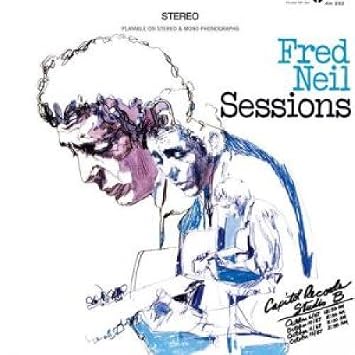
  • Fred Neil, Sessions (Capitol, 1968) CD reissue
Fred Neil - Sessions - Amazon.com Music
"Send Me Somebody to Love"

 Sessions was my first Fred Neil album, snatched up the year it was released.  For its time, it followed the radical concept of creating an album mainly of loose, all-out jamming by Neil and his cohort of studio pros, as if the audience were a fly-on-the-wall observer of the performances, warts and all.  The only precedent to this kind of "concept" album I can recall was The Beach Boys Party album in 1965, although that "party" atmosphere was a carefully constructed fake.

For many years it has bothered me that the Sessions tracks contained on the otherwise-unbeatable Collector's Choice two-disc compilation The Many Sides of Fred Neil from 1998 contained an inferior take of the album's opening track, Neil's "Felicity."  It used instead a shorter, less interesting take featured on another Neil album, Other Side of This Life.  I just had to have the real thing, so I arrived eventually at this pristine CD reissue.

Other than the first two or three tracks, it requires a degree of patience to listen through a presentation of this sort, well-edited though it is.  The lyrics to "Merry Go Round" are deep ("Where's the Jim Crow section of your merry-go-round?/ I just can't find the back," and I always feel the same thrill as the band after their finish of "Looks Like Rain";  "Wheeee!  Fly United!"


This set is a splurge, but I had to have it:  Miles Davis's complete Newport Jazz Festival performances from 1955, 1966 and '67, 1971, 1973, and 1975, spread over four discs.


Miles at Newport, 1955


NEXT: Kimson Plaut

Saturday, March 27, 2021

Sweet Insanity


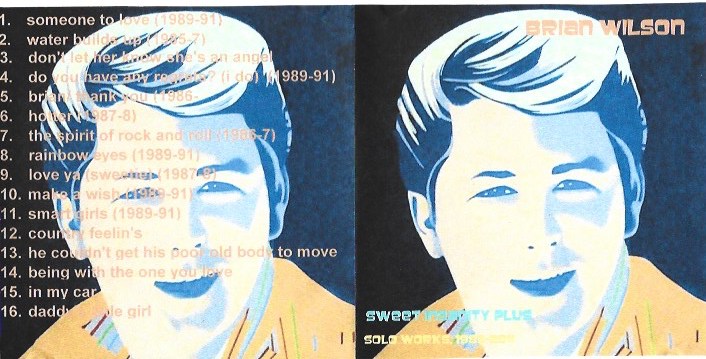
  • Brian Wilson, Sweet Insanity: from the original cassette version submitted to Sire Records by Dr. Landy in 1990. 


Some new thoughts on a lost Brian Wilson album.

Two segments from the "official" ESQ video of the Beach Boys Fan Convention in San Diego, August 1990.  ABOVE:  Brian Wilson performs at the piano for an audience of perhaps 300.  (My brother and I are prominent in the reverse-angle shots from behind the piano, over Brian's left shoulder.). BELOW:  Brian, Gene Landy & Co. at the Hard Rock Cafe downtown, after the fan convention.


Sweet Insanity, as a bootleg release-- I got mine on downloads-- came in two versions:  the first included more songs, but the other had superior sound quality.   Of the ten cuts (plus five extraneous tracks on my copy), four-- "Make a Wish," "Don't Let Her Know She's an Angel," "Rainbow Eyes," and "Let's Stick Together (outfitted with new lyrics by Van Dyke Parks and retitled "The Waltz") went on to "official" release in new versions on Gettin' In Over My Head in 2004.  The original versions, however, were superior to the issued ones.


IN ROTATION:

To repeat myself from a prior post:  Beyond any doubt, Orange Crate Art is the single best release of 1995.  As one would expect, Van Dyke Parks's instrumental arrangements are lush and Wilson's multitracked vocals, arranged also by Parks (though they fit Wilson's voice as well as if he himself had done the charts) are some of the best of his later career.  (Why did Parks enlist Wilson for the vocals?  "Because I can't stand the sound of my own voice," he once explained.) All of the tracks are little marvels, from the opening title track through the instrumental "Lullaby" by George Gershwin, but my favorites are the loping-along Western epic "San Francisco" and the nostalgic "Turn Back Time," which manages to do just that with a magnificent harmonic shift in its chorus.  The majority of the songs celebrate the same California settings that are depicted in the package's artwork.


What a wonderful world...


Brian Wilson & Van Dyke Parks prep expanded 'Orange Crate Art' reissue,  share new video


  • Kenny Dorham, Quiet Kenny (Riverside, 1951)

Quite possibly the best of KD.

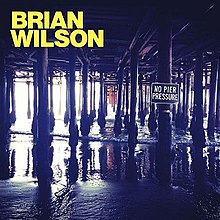
  • Brian Wilson, No Pier Pressure (Brimel/ Capitol, 2015)
My first real hearing in the nearly seven years itr's been out. 


No Pier Pressure.jpg


NEXT: The Four Freshmen


Tuesday, March 2, 2021

Brian Wilson Exclusive

I was fortunate to attend and record a talent-packed songwriter's conclave at the Will Geer Arboretum, in Topanga Canyon, Los Angeles, in June of '96 (out west to commemorate my mom's 75th birthday two days later).

After several false starts, I finally learned how to upload this video to the blog, a major achievement from an alter cocker.  Please enjoy it here,  in four parts: 


IN ROTATION:

Vinyl mania!


  • Duke Ellington, "Retrospection," "Nobody Was Lookin'" b/w "Afro-Bossa Piano Summations (D.E.T.S., 1962, 1964)  Jerry Valbern, Duke Ellington Study Group Convention, Detroit, May 16-17, 1984


  • Duke Ellington, Treasury Series No.  (D.E.T.S. LP, 1945)
Complete Script:

Sides A and B:  Olympic OL-7129 (E)


Lightly and Politely


Lightly and politely

another batch from LCPL:


It's hard to overstate my esteem for this peerless musician, one of whom I was aware early on but came to really appreciate much later, thanks to the person on the Duke-LYM list who recommended Water from an Ancient Well.  What a long, distinguished discography Ibrahim has given us.  I greatly regret never having had the pleasure of hearing him in concert and the decreasing possibility that it will ever happen.

This 2019 release (his next to last) is extraordinary in itself.  Ibrahim's longstanding ensemble Ekaya, which together with the leader formed a nonet of five reeds and winds, one trombone, and three rhythm to produce a sound unique unto itself, however personnel have varied over many years.  I don't recognize the names of any of the sidemen on this recording, though I surely expect to do so in the future.


  • Larry Coryell and The Eleventh House, Seven Secrets (Savoy, 2017)


  • Sonny Rollins, Road Shows Vol. 4:  Holding the Stage (Sony/ Doxy/ OKeh, 1979-2012)  released 2016;  various live performances from Europe and America


  • Lennie Tristano, Chicago April 1951, Uptown)


  • Paul Bley, Gary Peackock, and Paul Motian, When Will the Blues Leave (ECM, ????)


NEXT:  Sweet Insanity


Thursday, December 31, 2020

No Laughing Matter

Another undergraduate opus, this one from May, 1968.  It was submitted to a class on Victorian theater taught by the late film critic Harry Geduld, who I was sad to learn died in 2016.


Edwardian Comedy:  an Analytical Overview

Great comedy has traditionally distinguished itself as the most deadly serious form of literature.  At the Dionysian festivals in ancient Athens, an audience at the morning's round of tragedies might well have experienced sublime catharsis in witnessing the fundamental order of the universe proclaim the dignity of man and the sanctity of his values, only to return in the afternoon to find the one deflated and the other mocked by a scathing indictment by Aristophanes.  Both Ben Jonson, in the preface to Volpone, and Molière, in the preface to Tartuffe, deemed it necessary to mute the devastating effects of their respective plays, by qualification, argumentation, and sheer retraction, if only to save themselves from their shocked audiences, to whom self-recognition among the ridiculous characters on stage came as no laughing matter.  Similarly, in the plays of Congreve the moral and social didacticism is as inextricable from the substance of the drama as is laughter from its effect on an audience.

The beginning of the Twentieth Century witnessed a renaissance of comedy with a "message," a comedy no less serious than the naturalistic drama of Ibsen, Strindberg, and Chekhov, with which it shrared a great many of its own origin and aims.  The former, as it were, came about as a response to the latter, a parallel development of essentially the same dramatic material, which differed fundamentally in its point of view.  Bernard_Shaw, who was first among British critics to recognize the birth of modern drama in The Quintessence of Ibsenism, has since been acknowledged as the creator of the quintessence of modern comedy, for his work brought to fruition the new comedy of social and philosophical awareness that has developed into the dominant mode of dramatic expression in the Twentieth Century.  The Shavian tradition has been the determining force in the contemporary development of comedy as social criticism.


George Bernard Shaw

No less significant has been the new directions of dramatic criticism since the latter quarter of the Nineteenth Century.  This critical trent, which marks the origin of modern comic theory, has tended to proceed upon either of two lines:  the first, conceived by George Meredith in his "Essay on Comedy" (1877), defines comedy chiefly in terms of the social and economic structure of its audience, and is relative to the Marxist philosophy of historical materialism; the second, delineated in Henri Bergson's essay "Laughter"  (1900), attempts to locate the essence of the comic through an analysis of the laughable or ridiculous, and owes its inception to the Darwinian controversy of the Victorian era-- a philosophical and psychological approach which culminated in the Freudian interpretation of literature.

            George Meredith                                                        Henri Bergson


There exists an irony in the fact that these two traditions of criticism-- social and literary-- met each other eventually and brought about a reversal of roles:  the dramatists became, in effect, critics of society and social philosophy, while the philosophers and interpreters of society, correspondingly, exercised their ingenuity at literary and dramatic criticism.  The Twentieth Century is, perhaps above all else, the age of self-consciousness, and modern comedy has served as a means by which the dramatist has appreciated his own role in contemporary society and has examined the relationship of that society to the quality of dramatic art.  In the history of English drama, this crucial juncture between comedy and criticism, for the first time since Dryden, occurred in the Edwardian age.

Meredith's lament that "good comedies are such rare productions that... it would not occupy us long to run over the English list," and that "the comic poet is not a frequent apparition" (Meredith, 3), is indicative of the decline of comedy, and of the English theater in general, in the Nineteenth Century.  High tragedy had long since been reduced to its lowest terms and had degenerated into sentimental melodrama, a decline that can be traced to, among other things, a significant change over the years of the social topography of England and a corresponding change in the nature of the British theater-going public, no longer the aristocratic coteries that had dictated standards of public taste up through the Eighteenth Century.  The largest single factors in this sociological trend were the enormous increase in population, the public mind's association of the theater and the lower classes, and the enormous changes in patterns of living as a result of the means of production and distribution initiated by the Industrial Revolution.  Melodrama was in many respects the tragedy of the small man, the British equivalent of the tragédie bourgeoise, and, since it was to the tastes of the British population, that successful theater appealed, from popular melodrama there is much to be learned about the Victorian popular mind.  Melodrama signifies a defiance, a refusal to believe, a reaction against the decline of aristocracy (in the traditional sense), the enormous hardships and increasingly mechanized way of living forced by the industrial system, and the redefinition of man being undertaken by the sciences, particularly the one proposed by Charles Darwin.

 If melodrama reflected the retreat from reality in the form of an evangelical pipe-dream that the popular mind  undertook in response to the  great socio-economic upheavals of Victorian England, by the same token farce represented a parallel development in the opposite direction.  Farce, like melodrama, was evidence of the democratization of the British theater; i.e., farce signifies comedy reduced to its most basic components.  Moreover, the genre reflects a somewhat painful acceptance of the realities of the times, of the chaotic and arbitrary course of nature, and of man's helplessness in the face of the power of mere circumstance and coincidence.  And it is primarily in farce, rather than melodrama, that the seeds of modern naturalistic drama are to be discovered.  Generally speaking, objectivity and realistic perspective have always been more essential to comedy than to tragedy, and since by the turn of the century modern drama and dramatic criticism determined that realism was the temper of the times, inevitably it was comedy, not tragedy-- farce, not melodrama-- that received the honor of sustaining the British theater and carrying it forward into the Twentieth Century.  As the Nineteenth Century sounded the death-knell for tragedy, it simultaneously produced the clarion call for a new golden age of comedy.

Was Edwardian theater a fulfillment of Meredith's dream of a return to the high comedy of  Molière and congreve?  Meredith maintained that such a development could occur, provided that certain sociological conditions would be in effect:

A society of cultivated men and women is required, wherein ideas are current, and the perception quick, that [the great comic poet] may be supplied with matter and an audience.  The semi-barbarism of merely giddy communities, and feverish emotional periods, repel him; and also a state of marked social inequality of the sexes; nor can he whose business is to address the mind be understood where there is not a moderate degree of intellectual activity.  (Meredith, 3)

Whether or not these are valid criteria for the sociological support of the comedy Meredith had in mind, the Edwardian period compares quite favorably, in various degrees, with all of them.  Further, the caliber of the Edwardian dramatist, with Shaw at the head of a gifted and distinguished list, was certainly capable of creating comic drama that could stand beside virtually any of the masterpieces of comedy that English literature had theretofore produced.  Yet into the Twentieth Century, even through the present time, the legacy of farce has prevailed over that of the comedy of manners in the shaping of modern comedy.  For all his literary appreciation and sociological perception, Meredith failed to look to his own age for the dominant institutional trends toward the society and the theater of the future; it appears as if the appalling dearth of quality in the Nineteenth Century British theater were indicative of little more than a horrible accident of history, in Meredith's view.  Even as Ibsen was gaining renown in the revolutionary Free Theaters in Berlin and Paris, Meredith refused to appreciate the significance of the modern dramatic movement or to acknowledge the potential of the comic muse in the era of realism.

The hallmarks of Edwardian comedy remain somewhat elusive to generalization and definition, both historically and dramatically speaking, for the age was one of transition, between the optimism of Empire and the pessimism of World War.  In the theater the order of the day was reorganization and experimentation; already at hand among modern dramatists were deep divisions of purpose and a wide variety of approaches, each with a dramatist's manifesto rushed to its defense.  In a period of some ten years there British theater had achieved a range-- from Shaw, Galsworthy, and Hankin to Granville-Barker, Maugham and Barrie-- that it had not seen for more than a hundred years.

With few exceptions, however, it could be said of Edwardian comedy that the drama reflected the concerns of its time in its urbanity and sophistication, its willingness to attack social problems positively and directly, its nouveau-riche pretentiousness and cluttered quality, and its increasing preoccupation with the intellectual controversies of the Twentieth Century.  All of these concerns, with the possible exception of the last, derive a certain significance from the fact that they describe only the texture, the surface consistencies of Edwardian comedy.  This is appropriate enough for a society whose main preoccupation seems to have been surface, external appearance itself.  And in Bergson's view, the essence of comedy-- the psychology of laughter-- lies precisely in the relationship between the inner human being and the surface he exposes to the world.

More specifically, Bergson finds the ridiculous to reside in man's rigidity, in the restriction of the Élan_vital, in "something mechanical encrusted on the living" (Bergson, 84).  His critical rule-of-thumb is, "We laugh every time a person gives us the impression of being a thing" (97), and he goes so far as to state , "The attitudes, gestures and movements of the human body are laughable in exact proportion as that body reminds us of a mere machine" (79).  In considering Edwardian comedy from this philosophical and psychological perspective, the other end of the spectrum of modern comic theory has been sighted.  It would do well at this point to cull an example from the period, in order that the relationship between the two lines of criticism may be further explored.

The "mechanical" indeed finds a place in St. John Hankin's comedy, The Return of the Prodigal (1904), and is highly responsible for the comic element of the play.  A rigid mechanization prevails over not only the characters (e.g., Mr. Jackson and his son Henry), but situations as well, and even much of the language in the purely comic exchanges:

Eustace, bored:  Quite so.  Whose carriage was it by the way?

Baines:  Sir John Faringford's, sir.

Eustace:  Well if one's head is to be driven over, it may as well be by a member of the aristocracy, eh Baines!

Baines:  Certainly, sir.

            (Hankin, 103)

In fact, one of the major themes of Prodigal is concerned directly with the rigidity of the Edwardian social order, the lack of class mobility, and the parvenu's struggle to cope with the conventions of such a system. The "mechanical," it would appear, has played an enormous role in the everyday life of Twentieth Century bourgeois society.

This view of modern life was expressed considerably earlier by Marx, who considered the capitalist economy responsible for turning man into an extension of the machine.  The relationship between the comic and the economic becomes clear at this point, and as laissez-faire had its heyday in Edwardian England, it is quite understandable that comedy should have functioned as vital a part as it did in contemporary social criticism.  The analogy can, of course, be extended to help explain the phenomenon of the dominance of comedy, throughout the Twentieth Century, in social thought of the Western industrial nations.  In addition to the social rigidity resulting from economic determinism, a parallel can be recognized in the biological-- and metaphysical-- determinism that has functioned as a corresponding strand of modern thought.

This biological determinism is the obsession of Eustace in The Return of the Prodigal:

It's not what I do but what I am that is the difficulty.  What does it matter what one does?  It's done and then it's over and one can forget it.  The real tragedy is what one is.  Because one can't escape from that.  It's always there, the bundle of passions, weaknesses, stupidities, that one calls character, waiting  to trip one up.  Look at the governor... Do you suppose he could be like me if he tried.  Of course not.  Nor could I be like him...

Aren't we just the creatures of our upbringing, of circumstance, of our physical constitution?  We are launched on the stream at our birth.  Some of us can swim against the current.  Those who can't, it washes away.  (133)

What Hankin put into the above passage was nothing more than the philosophy of Naturalism, a primary force in modern drama taken to its logical conclusion, an integral assumption of comedy, that man is a predetermined victim of his environment and heredity.  But the rigidity imposed by biological determinism is laughable to us only as long as we are unable to identify ourselves personally with it.  Bergson perceived what is probably the fundamental psychological condition for laughter when he noted, 

... the absence of feeling which usually accompanies laughter.  It seems as though the comic could not produce its disturbing effect unless it fell, so to say, on the surface of a soul that is thoroughly calm and unruffled.  Indifference is its natural environment, for laughter has no greater foe than emotion.  (63)

To the extent that this is true, it would appear that laughter, as Freud conjectured, is an expression of man's sadistic impulse.  We must feel a certain sense of superiority over the objects of our ridicule, for "objectivity" can denote little more, in Twentieth Century epistemology, than a sense of mastery over a subject, marked by a lack of sympathy or empathy; that is, the maintenance of a certain emotional distance between ourselves and the objects under consideration.

Because our self-esteem is largely dependent upon our conception of the self as a free agent, we are reluctant to accept a deterministic explanation of our own behavior.  It is only with a profound dismay that we realize the power of fate and circumstance in our own lives, and even then, we can never fully identify ourselves as insignificant cogs in the machinery of the universe.  For this reason we can never truly laugh at ourselves, because by nature the human mind conceives of itself as an active agent, rather than a passive object.

Hence the motif of despair in Twentieth-Century literature.  Determinism has signified a fall from grace that has immeasurably affected our intellectual life, and contemporary art has reflected the schizoid tendency of the modern mind resulting from the paradox of the subjective viewpoint in conflict with the objective intelligence.  The metaphor of man's divided soul has captured the spirit of the arts, and is highly relevant the current revolt against formalism in literary criticism.  The destruction of Form, of the distinctions between comedy and tragedy, has developed into the preoccupation of an entire school of dramatic criticism, and receives its most comprehensive treatment in the plays of Luigi Pirandello.


Bibliography

Lauter, Paul, ed.  Theories of Comedy.  Garden City:  Doubleday, 1964.

Sypher, Wylie, ed.   Comedy:  "Laughter," Henri Bergson; "An Essay on Comedy," George Meredith.  Garden City:  Doubleday, 1956.

Weals, Gerald, ed.  Edwardian Plays, including The Return of the Prodigal, St. John Hankin.  New York:  Hill & Wang, 1962.  

IN ROTATION

A needle-drop CDR from the vinyl LP, this is one more of a long series of recordings featuring my homeboy from Indy, pianist Carl Perkins; his rhythm-section mates include Joe Comfort on bass and George Jenkins on drums or Mike Pacheco, congas.  The performances stem from two recording sessions, from September 1954 (billed as Oscar Moore Trio, Featuring Carl Perkins) and June 1955, both featuring Moore as primary soloist.


Perkins, fortunately, gets a bit of space to strut his stuff.  Without percussion, the sets very much would resemble the Nat Cole Trio, of which Moore had been an integral part.  Highlights include the series of "fours" with congas that climax "Samson and Delilah" and "Roulette," taken 'way uptempo with drummer Jenkins on brushes.  Moore's opening solo on a beautiful rendition of the ballad, "Dinner for One, James."

NEXT:  The Latest Poop


Friday, December 18, 2020

The "Root of Evil" in The Pardoner's Tale

This being December of a presidential election year, only weeks prior to the departure of the present Administration, the subject of official pardons (many sold for cold cash, without doubt) has become particularly pertinent.  My undergraduate take on Chaucer and his  "Pardoner's Tale" thus takes on new relevance.

Paul Strohm: Chaucer's Tale (2015) - Folgerpedia

Paul Strohm

My original MS is dated May 1, 1968, for L219 Prof. Anderson, but I'm quite certain I submitted it first to Dr. Paul Strohm, with whom I was able to stay in touch for some years, particularly to express our mutual enthusiasm for the works Thomas Pynchon.  Since the last time we saw each other at IU's Ballentine Hall or his off-campus apartment, I now read that Prof. Strohm has risen to dizzying heights in the academic world:  a long stint at the University of Oxford, and at present a chair at Columbia in New York.  I'm set to read his recent essay, "The Man Who Insulted Shakespeare."

A work of pure imagination.

I wonder what Paul  (not to mention Pynchon) is up to these days?


Portrait of Geoffrey Chaucer (4671380) (cropped) 02.jpg


"Radix malorum est cupiditas," proclaims the Pardoner at the beginning of each of his sermons: avarice is the root of evil.  But in an even larger sense than the Pardoner's sententious and cynically loaded references to avarice imply, the tale raises the question of the "root of evil" in a world which God called good at its creation.  The Pardoner suggests that it is avarice and its-- and its counterparts glotonye, luxure, and hasardrye-- which is responsible, ultimately, for the sin of the world, and this explanation suffices in a cursory interpretation of his tale.    Yet such an analysis seems to do no justice at all to the question posed by the tale and invites a deeper inquiry as to the significance of avarice and the location of evil within (and without) the context of the tale.

The Pardoner founds the substance of his sermon on this paradox of evil, the ironic ingratitude of man:

Allas, mankinde, how it may bitide

That to thy Creatour which that thee wrought,

And with his precious herte blood thee bought,

Thou art so fals and so unkind, allas.

(11. 572-5)

From this fundamental irony grows a multitude of smaller and more complex ironies.  Not only the mechanism, but also the very substance and the surrounding context of "The Pardoner's Tale" is an artfully compounded irony and paradox:  the Personification/ super naturalization of Death, the juxtaposition of the revelers and the old man, the significance and poignancy of everyday remarks, and, behind the scenes as it were, the Pardoner himself providing the living exemplum of avarice by manipulating the Christian desire for salvation to serve his pocket, using every sordid trick of his trade to prove that even a hypocrite-- again ironically-- can practice precisely what he preaches.  The magnificently vital (and highly familiar) harangue against the sins of gluttony, lechery, and gambling is but a skillful ploy to gain our money.  It is indeed avarice that provides the undoing of the Pardoner himself, as well as his three revelers, as it is specifically their unbridled greed which causes them to to pervert their respective moral missions, forget their respective susceptibility to sin and moral ruin, and meet destruction.  The key episode in the tale of the revelers is the encounter with the old man, who himself seeks Death and realizes that sin and death come fully only to those who are unmindful of its omnipresence and who expect it least.  Thus are the revelers led to forget their mission to destroy Death, and it is avarice that reverses the situation and pays them all in kind.

But it is this same episode with the old man that leads us to suspect that it is something other-- or, rather, something more-- than mere avarice that is responsible for the mind of the sinner and is, hence, the catalyst of his undoing.  The old man recognizes something more than avarice in the revelers, something more explicitly integral to their nature, and that is the arrogance of their youth out of which they mock and humiliate him.  Tho old man sees this arrogance, this pride, as the source of man's potential for sin:

But sires, to you it is no curteisye

To spaken to an old man vilainye

But he trespass in word or elles in deede.

In Holy Writ ye may yourself wel rede,

"Agains an old man, hoor upon his heed,

Ye shal arise."  Wherefore I yive you reed,

Ne dooth unto an old man noon harm now,

Namore than that ye wolde men dide to you

In age, if that ye so longe abide.

And God be with you wher ye go or ride:

I moot go thider as I have to go.

            (11. 411-21)

 This pride, of course, is more than the rudeness youth shows to age.  It appeared earlier in the tale in the manner of one of the revelers toward his servants, and in fact pervades the entire attitude of the revelers toward the Death they seek to kill; their pride makes them incapable of conceiving of Death as anything greater than a neighborhood bully who deserves a thrashing.  And while the object of setting out to rid the world of death is a noble idea derived from an essentially Christian sentiment, it is also as arrogant as it is ignorant of the power of Death and the fallibility of man.

Thus it is a kind of hubris that leads the revelers to their destruction; indeed, had their motives been higher, their station more exalted, and their perception greater, they might have been participants in a tragedy à la Oedipus, instead of a mere exemplum of the sin of avarice.  Avarice, within and without the tale, is indeed a sin; that is to say it is a result, an end-product of the flaw in human nature which permits man to sin.  The Pardoner's Tale locates this flaw in man's pride, his proneness to overextend himself, his tendency to challenge those those things (e.g. Death) which are beyond challenge.  In the same vein, the Pardoner exhibits pride in his cynical attitude toward both his subject and his listeners, the attitude that he alone is immune to punishment for the same sin he would have others eschew.  Chaucer's epilogue to the tale gives us the satisfaction of seeing the Pardoner cut down to size.  

  IN ROTATION

Voz e Violão
Gil Luminoso cover.jpg
JoaoVozeViolao.jpg


Lightly and Politely


 CosmicTones.jpg


NEXT:  Lenny Bruce