Search This Blog

Wednesday, June 2, 2021

Three Takes on The Roaring Twenties

NB:  Here are three papers from an American Lit class at Northeastern Illinois University, Fall semester 1974, in pursuit of credits required for my teaching certificate.

I don't really care whether they're good or not.


 Anderson, Hemingway, and the Prospects of Civilization

Sherwood Anderson once wrote that Winesburg, Ohio was meant to illustrate "the environment out of which present-day American youth is coming."  The author wished his book to be taken as a commentary on the origins of the generation that had inaugurated the twentieth century in America.  It is as such that I wish to compare Winesburg to Ernest Hemingway's In Our Time, which appeared in 1925, six years after the completion of Anderson's book.

The two books are comparable, of course, on many other levels.  Both are collections of short stories, each more or less self-sufficient as such, which are connected by theme and, to a certain extent, by their principal characters.  The stories of both authors show a rejection of the highly mannered genteel traditions of writing which had marked nineteenth-century British and, by imitation, American literature.  In content both books deal with the commonplace; their characters are ordinary Midwesterners, whether living out their lives in Winesburg or transplanted to an Italian resort; their styles are both colloquial, designed to be read by a mass audience.  Most significantly, both authors shun the convention of the "well-made" story, with carefully structured beginnings, middles, and endings:  both seem to prefer stories to tell themselves, to illuminate their characters without clumsy insertions and interjections on the part of the authors.

Anderson's George Willard and Hemingway's Nick Adams are youthful protagonists from small Midwestern villages.  They can be taken to represent the American frontier and the future of American civilization, as it appeared to Anderson before the First World War and to Hemingway afterwards.  In spite of the great similarity in outlook which these writers share (and which I hope to demonstrate), on this central question of the American future they appear on entirely opposite sides.  The chasm that stands between them is the trauma of the World War.

Much of the tone and thematic material of Winesburg, Ohio is set forth in the book's opening chapter, called "The Book of the Grotesque."  Anderson describes the vision of an old man, a writer, who had known many people "in a peculiarly intimate way that was different from the way you and I know people."  This is the artist's ability to penetrate the depths of human emotions that ordinarily are not perceived.  The old man, in his vision, "imagined he young, indescribable thing within himself was driving a long procession of figures before his eyes."  These figures, all the human faces the writer had ever known, were drawn in all their human frailty and grotesque distortion.  While the writer found some of them amusing, one of the grotesques, "a woman drawn all out of shape, hurt the old man by her grotesqueness."  What had turned humanity into such a procession of grotesques, the writer thought, were the truths by which each person tried to live his life; "the moment one of the people took one of the truths to himself, called it his truth, and tried to live his life by it, he became a grotesque and the truth he embraced became a falsehood."

The stories that follow "The Book of the Grotesque" depict the lives of the inhabitants of Winesburg.  Anderson examines these lives in the same "peculiarly intimate way" as the old writer in his opening chapter.  Winesburg is built up, chapter by chapter, into  microcosm of a humanity whose members are condemned to live in emotional isolation from one another.  Each character inhabits a private hell of grief or ambition, loneliness or social ostracism, and each becomes a "grotesque" in the effort to escape this hell.  Just as the old writer is amused by the contortions exhibited in his vision, but is at the same time touched by the poignancy of humanity's plight, Anderson, too, allows his characters an unmistakable sympathy, without sacrificing his emotional distance from their self-destructive follies.

Sherwood Anderson


Hemingway's stories appear singularly devoid of that quality of pity which marks those of Anderson.  Whereas for the characters in Winesburg, social relationships appear at once as strait-jackets upon the individual as well as the means for his personal salvation, In Our Time presents them as entanglements full of hypocrisy and self-deception, almost as a kind of Original Sin.  Several of the stories illustrate this particularly well.  The institution of marriage is satirized in "Mr. and Mrs. Elliot," in which the puritan groom finds his sexual kick in poetry while his bride finds hers in a lesbian relationship.  The stories "Cat in the Rain" and "Out of Season" portray American couples in Europe, pampered by servants, bored with each other, and totally out of touch with life.

While with Anderson's characters sexuality stood as a point of communion between human beings, for Hemingway's characters it becomes the source of ruined lives, an entrapment.  The young veteran home from the war in "Soldier's Home" attempts to sort this matter out in his thoughts.  Watching some attractive young girls walking down the street, he muses:

He did not want them themselves really.  They were too complicated.  There was something else.  Vaguely he wanted a girl but he did not want to have to work to get her...  He did not want to get into the intrigue and the politics.  He did not want to have to do any courting.  He did not want to tell any more lies.  It wasn't worth it...  He wanted to live alone without consequences.  Besides he did not really need a girl.  The army had taught him that.  But it wasn't true.  You did not need a girl.  That was the funny thing.  First a fellow boasted how girls meant nothing to him, that he never thought of them, that they could not touch him.  Then a fellow boasted that he could not get along without girls, that he had to have them all the time, that he could not go to sleep without them.

That was all a lie.  It was all a lie both ways.  You did not need a girl unless you thought about them. He learned that in the army.

A comparison of the two authors' respective protagonists brings out this difference even more sharply.  George Willard, growing into manhood against the background of Winesburg, is shown in three separate sexual encounters (the chapters "Nobody Knows," "An Awakening," and "Sophistication.")  Each of these encounters marks a rise in George's development.  After the last, George and Helen white "had for a moment taken hold of the thing that makes the mature life of men and women in the modern world possible," and George is ready to leave Winesburg, a mature young man.

Ernest Hemingway

We are permitted to see Nick Adams in the company of a woman only once, in "The End of Something."  Exactly what is coming to an end is left vague:  Nick and Marjorie are together on a fishing trip, and Marjorie notices that Nick is uncomfortable.  After some prompting, Nick accuses Marjorie of "knowing everything," and finally confesses that love "isn't any fun any more."  After Marjorie leaves, we learn that Nick has considered breaking the relationship for some time.  In a sequel, "The Three-Day Blow," Nick's friend Bill raises the subject again and advises Nick:  "Once a man's married he's absolutely bitched.  He hasn't got anything more.  Nothing.  Not a damn thing.  He's done for.  You've seen the guys that get married."  It's all right to "fall for" women, Bill says, "but don't let them ruin you."  When Nick appears unconvinced, Bill offers the rationalizations that Marjorie was of the wrong class, that marriage would have brought her obnoxious family into his life, and then the comforting thought that Nick might be able to resume the relationship.  Nick is finally able to put Marjorie out of his mind as the two youths go outdoors with their shotguns and begin to walk across the snow-covered meadow:  "None of it was important now.  The wind blew it out of his head.  Still he could always go into town Saturday night.  It was a good thing to have in reserve."

Here, as in the rest of In Our Time, the masculine virtues of struggle and direct contact with nature appear to be the only positive alternatives to destruction by women and, implicitly, by civilized society.  With Hemingway, in contrast to Anderson, sex is not a matter of moral consideration or guilt or social obligation:  it is simply the invasion of the clean and pure male world by polluted females and the emasculation of men.  The only positive characters are men without women, alone and self-sufficient-- we get the idea in "Big Two-Hearted River"-- who shun society and risk death.  The suicide of the Indian in "Indian Camp" is perhaps symbolic of feminized society's encroachments upon the masculine frontier, and again in "A Very Short Story" the male war hero is ruined by women, first betrayed by an Italian nurse, and later having contracted gonorrhea "from a sales girl in a loop department store while riding in a taxicab through Lincoln Park."

The upshot of the comparison is that, while both Anderson and Hemingway saw the decay of American civilization and the corruption hidden beneath the surface of the American character, only Anderson held to the hope that this civilization and character was salvageable.  He has his protagonist grow in stature through his relationships, especially the sexual ones, in Winesburg.  He cherishes the notion that the sickness of humanity can be cured by a closer and more meaningful human community, through the sympathy and understanding which inform his artistic temperament.  Hemingway offers society not such consolation.  He has already seen humanity degenerate into barbarism, as he was a participant and a witness in years of the most unimaginable slaughter.  Each chapter of In Our Time is prefaced by a page dripping with blood and gore.  Civilization carries the curse of mankind; in its grasp, human emotions must be as cauterized and anesthetized as the casualties bleeding their lives away in war hospitals.  The world requires heroes who can, like the Battler, make an escape from civilization before it ruins them; their only alternatives are death, quickly in the form of suicide or slowly in the form of alcohol, and the adventure of direct struggle with the elements.  What is needed is a return to the clean and basic human feelings, uncluttered by the accumulated trapping of culture and civilization.

Hemingway's heroes have no future to face; they must live for the present.  It is perhaps for this reason that Hemingway allows them no involved and convoluted soul-searching or speculation.  While George Willard has drawn strength from his past associations and uses his departure from Winesburg as a springboard into the shining city of the future, Nick Adams must be forever turning back the clock, breaking his ties to the society that nurtured him.  He must retrace the footsteps of his namesake, from Sodom back to Eden.


Stevenson's Babbitts and Bohemians:  A Review

Any book attempting to do a panorama of an entire decade, especially one so rich and varied in texture and experience as the American 1920s, is faced at the outset with a series of fundamental problems.  First is the problem of the selection of material:  what events, trends, and personalities fall properly within the purview of this decade?  Closely related is the question of emphasis, of deciding the relative importance of one or another fact or theme perceived by the historian in the course of the decade's development.  Perhaps the central problem to be addressed, the one upon which all others depend, is the the adoption by the historian of a clearly defined historical method of inquiry, which provides a central thesis and point of departure for the study.

It is the absence of such a methodology which is the chief reason for the failure of a book like Babbitts and Bohemians (1) by Elizabeth Stevenson.  In no way is this to imply that Stevenson's book is unique in its failure:  so characteristic is it of a trend in American historical writing, that it can be said to typify the product of most recent historical writing in the United States, including works of more erudite and talented authors, such as Richard Hofstadter.  Again the absence of a clearly defined methodology does not at all mean that an author proceeds with no historical method whatsoever.  Stevenson travels the familiar road of eclecticism, presenting history as a kaleidoscope of disembodied ideals, public events, great men and false hopes.  Most significantly the drama of the 1920s is here played upon the stage of ideological neutrality, a characteristic pose of standard American history, which regards the burning questions of our time as unanswerable riddles.

The weakness of this approach reflects itself in the arrangement of the material into more-or-less chronological, rather than thematic chapters.  However, this is simply a technical objection; more important is the lack of any organic connection between the various aspects of life in the 1920s.  For example, Stevenson's chronicle begins with a backward glance to the America of the pre-war "good years" and an account of this country's participation in the World War, and it ends with a description of the great stock market crash of 1929.  Heralded by the most destructive period of slaughter in human history, and closing with an equally calamitous economic collapse, the 1920s are viewed by Stevenson as an interlude of relative political and economic stability between two extremes of international descents into barbarism and chaos.  In passing, from time to time, we are reminded that this period of stability in America did not extend to the rest of the world:  economic misery reigned in Central Europe and Japan, Britain and France were going through a series of political crises, and a socialist revolution had taken place in Russia.  Isn't it possible that the 1920s'prosperity in the U.S., which gave the outward appearance of political isolation and a widespread insular social mentality, corresponded directly to to the turmoil occurring in the rest of the world?  Moreover, isn't it likely that both the Great War and the Great Depression, not to mention the process of internal American social development, could have been thrown into much sharper focus if they had been examined from the standpoint of the chronic international crisis which [set the last] century apart from all others?

Stevenson does begin, promisingly enough, by posing the question,

Did American isolation from foreign affairs exist as a fact in the twenties?  If it did not exist, was not the passionate belief as important as fact?  To begin again:  the decade usually though of as one wrapped in isolation was in reality the time of the end of American isolation.  This separateness had started crumbling in the years of the Spanish-American War, when the people of the United States acquired off-handedly some of the colonies of Spain.  Isolation was finished in 1917, when American troops went to France. (2)

This, if anything, is an understatement.  Having become a full-fledged imperialist power by the end of the nineteenth century, the United States at the time of the Armistice was universally recognized as the world's leading military and industrial power.  The hegemony of European power, that of the Entente countries and the Central Powers as well, had been smashed, and the way was cleared for an enormous expansion of American capital into all sectors of the world market, with the significant exception of the Soviet Union.  Without this perspective of world politics and the world's economy, Stevenson is simply not equipped to discuss the Versailles Treaty, the period of "normalcy," the Dawes Plan, the Panic of 1929, or any of the other momentous international developments with which she so gingerly fumbles.

This perspective, in addition to clarifying 1920s' international diplomacy, would also go a long way toward explaining salient developments within American society, especially when taken with a full understanding of the accident of geography which had allowed the U.S. to absorb an enormous part of the North American continent, and to avoid the social trauma of a World War fought on its own territory.  Even the surface aspects of the period-- the moral crusade of Prohibition, the furor over Teapot Dome, the emergence of the flapper, the philosophies of pragmaticism and American exceptionalism, the hard-boiled "success" orientation that the advertising industry laid as the cornerstone of a new American character--  the the ingredients which go to make up the flavor of the 1920s are best understood the context of America's new domination of world affairs.  Has not a new dimension been added to the American Dream ideology with the understanding that this country is now "the biggest and the best"?  And does it not follow that a new sort of Americanism was in demand, in order that America might better perform that new role?

To be sure, these comprise only the superstructure of American life during the 1920s.  Stevenson touches upon some of the more basic forces at work in society, but here, too, without the guidance of historical perspective or ideological conviction.  In the history of the American labor movement the decade of the 1920s is generally seen as a period of lull which preceded labor's greatest triumphs, in the huge strike struggles and industrial organization of the 1930s.  On the other hand, for American business the 1920s was a period of almost uninterrupted expansion and consolidation, up to the onset of the Depression at the end of the decade.  It is not surprising, therefore, that beneath the glittering surface of the 1920s we should witness massive battles of classes in conflict.  It is the story of a disoriented and unorganized working class retreating before the most powerful ruling class in history facing unparalleled opportunity and filled with confidence from the spoils of war.

Aside from the fact that Stevenson does not make the important connections between the war and the relative positions of capital and labor, I find her treatment of some of the major events and figures of the labor movement especially irritating and misleading. (3)

I would submit that these "mischievous little boys," with their following of thousands of radicalized workers and their program of industrial unionism, held the key to the transformation of American society during the labor upsurge of the 1930s, the likes of which have not been seen in America before or since.  Likewise, I would object to Stevenson's caricatures of major figures of the radical movement, such as William Z. Foster, Big Bill Haywood, and particularly Eugene V. Debs, that lion of the labor movement, whom Stevenson describes as "the mild and seraphic apostle of Socialism." (4)

It must be stated emphatically that this period of history cannot be understood in its true outlines without a true appreciation of the experience of the labor movement, up to and including the 1920s.  This would include not only the rise and ultimate failure of the IWW, the decline of the American Federation of Labor under Gompers's leadership, and the foundering of the Socialist Party in the postwar period, but also the founding of the American Communist Party and its development under the impact of the Russian Revolution.  Stevenson devotes considerable space to the Palmer Raids in 1919-20, the steel strike in 1919, the rise of the Ku Klux Klan, and the legal lynching of Sacco and Vanzetti.  But she fails to connect these developments into a process of American labor in its struggle against capital.  She draws no conclusions and the events remain meaningless, not only in terms of the overall tone of the 1920s, but perhaps more importantly in terms of the situation labor faces in the 1970s, where many parallels can be found to the social and political atmosphere that existed fifty years ago.

Stevenson's appraisal of the literature of the 1920s suffers from this same failure to appreciate the extreme social tension that underlay the placid surface of life in the 1920s.  While noting that"in the twenties art was to separate itself from a climate of persuasion or conviction," that it was "to be defined by style rather than ethics," (5)  she draws no co0nclusions regarding the connection between this kind of art (or the trend of art criticism which took flight along with it) and the deeper social issues in American life.  Is it not possible to relate the retreat of the working masses in America to to the retreat of her most gifted young men and women into a personal world of "art for art's sake" and a bohemian rejection of the world in which most of us live?

I have identified Stevenson's method as an eclectic one, which chronicles and labels events without drawing much attention to their internal consistency.  Such an approach, so characteristic of whitewashed history served up by liberal apologists of American social policy, will not provide the tools necessary to discover the dynamics of the forward movement of this century.  It belongs to the past, along with the flapper and the sliver, and historians will one day discuss it as another relic of the period of America's most significant social transformation.

Endnotes

1.  Elizabeth Stevenson, Babbitts and Bohemians:  The American 1920's (New York, Macmillan, 1967).

2.  Ibid., p. 6.

3.  Ibid., p. 16.

4.  Ibid., p. 41.

5.  Ibid., p. 79.


Literature of the 1920s:  A Social Crucible

"You're an expatriate.  You've lost touch with the soil.  You get precious.  Fake European standards have ruined you.  You drink yourself to death.  You become obsessed by sex.  You spend all your time talking, not working.  You are an expatriate, see?  You hang around cafes."

"It sounds like a swell life," I said.  "When do I work?"

Putting this banter into the mouths of his characters, Hemingway seems to have captured the myth that public opinion has created of the literature of the Twenties.  It has become a cliche that the fiction and poetry belonging to this period is "irresponsible" stuff, the immature product of a "lost generation" of American writers.  Yet it has never been explained how this literature is any more "irresponsible"than the American writing that preceded it.  And seldom has the social background which gave risotto this generation of writers been put into the kind of perspective that allows a meaningful investigation of the development of American culture.  It must be added that such labels appear doubly odd, when applied to a body of writing commonly accepted as representing a "second renaissance" of American literature.

 It may be instructive here to cast a glance at America's first Literary Renaissance, of the period 1845-55.  Like the 1920s, this was a period of economic expansion, strident voices, and intellectual ferment.  It was also a time of impending  social crisis, which was to usher in a second American Revolution to replace the social system of slavery with that of industrial capitalism.  These events certainly touched Hawthorne, Poe, Melville, and Whitman, and to a certain extent the pressures exerted in political and  social life shaped their finest work.  But can anyone deny that, apart from the work of abolitionist pamphleteers, these pressure were expressed only intermittently and by and large indirectly?  One has the right to wonder why, given the enormous social tension of their times, These writers are not similarly smeared as "irresponsible" or "decadent."


William Faulkner


If it is permissible, according to the social and literary polarities of the 1850s, to designate Hawthorne and Whitman as the great "nay-sayer" and "yea-sayer" of their time, it may be useful here to seek a similar polarity of opinion with respect to the literature of the 1920s.  However true it is that this decade did not find the nation on the brink of armed insurrection and civil war, it may be observed that the literature of the Twenties reflected very real tensions in American society, even more deep-rooted and often more intense than those which divided the country in the 1960s.

One of the key problems that was to emerge in the writing of the 1920s was the artist's perception of his isolation and alienation from the rest of society.  The roots of this phenomenon, common to all advanced industrial societies of this century, lie in the contradictory effects exerted by capitalism on cultural life:  while on one hand the enormous expansion of industry and commerce has required the growth of literacy and institutions of public education, an equally strong tendency has operated in favor of increasingly narrow areas of specialization of occupations and the accentuation of cultural boundaries.  This latter tendency has created the modern "intelligentsia," composed of scientists, professors, journalists and artists, as a more-or-less distinct layer of contemporary society.  This social background has bee responsible for what is perhaps the chief dilemma of the modern artist.  With the increasing destruction of traditional social relations, the artist can no longer be the voice of folk tradition; he is faced increasingly with the prospect of producing cheap trash for the commercial market (i.e., "making a living") or producing "fine art" for exclusive consumption by the educated elite.  Hence the artist's dilemma reflects Marx's famous dictum that bourgeois society "has left remaining no other nexus between man and man than naked self-interest, than callous 'cash payment.'"  Ultimately it is this same "cash nexus" that gave rise to the cult of the artist, which from the 1920s on has been the predominant feature in American cultural life.

I have already mentioned the usefulness of considering the writers of this decade ass "yea-sayers" or "nay-sayers" with regard to the prospects of American civilization.  A clarification is needed here, however:  not a single one of the outstanding writers of the 1920s hailed the society which they knew as the fulfillment of the American Dream.  On the contrary, their evaluations of society ranged between Elliot's "waste land" to Faulkner's "tale told by an idiot."  The important question dividing these writers, one that has strong connections to the mythology of America as a second Eden, was whether modern society had any hope of salvation.

Theodore Dreiser

Among the "Nay-sayers" we should consider Lewis, Wharton, Fitzgerald, Dreiser, and pre-eminently Hemingway.  Of these five writers, Lewis presents the most paradoxical figure, that of an artist who became wealthy and famous by attacking the institutions of wealth and fame.  Lewis possessed perhaps the strongest social awareness and the least artistic insight of all the writers of the 1920s.  Despite his reputation as a muckraking reformer, he never was able to imagine any consistent counter-tendency to reverse the slide of American society ito the swamp of middle-class mediocrity and smugness.  Gopher Prairie and Zenith City represent the utmost pinnacles which American society as capable of scaling.  Lewis's pessimism springs simultaneously from his repulsion from the values of his own middle class and from his short-sighted estimation in the unshakeable future of that class.

Sinclair Lewis

Fitzgerald and Dreiser likewise expressed an ambivalent attitude toward the crass commercialization of culture.  By an inversion of the Horatio Alger myth, Fitzgerald's characters Gatsby and Diver are destroyed along with their dreams, and a similar scenario brings Dreiser's Clyde Griffiths to the electric chair.  Both authors were strongly influenced by the Spenglerian and Spencerian philosophies which heralded the collapse of the ideals of Western civilization and the triumph of the strong over the weak.  Dreiser's An American Tragedy is a particularly vivid expression of middle-class disillusionment and despair, a portrayal of the human being as a helpless victim of his own "chemist" and a pawn of social forces beyond his comprehension or control.

However it is undoubtedly Hemingway who will remain as the most enduring example of the artist's estrangement and pessimism.  It was Hemingway who exalted stoicism and despair to a kind of psychosis, who reduced the pessimism of the "nay-saying" current to a chant of nada.  He holdout not the slightest hope for a meaningful existence in human society, and, in a manner which to a certain extent parallel the more developed ideas of D. H. Lawrence, cherished a return of humanity to the barbaric innocence of a gut-level existence.  The only possible consolation left to human beings smothered by civilization is the code of the Hemingway hero:  knowing how to behave well, to exhibit "grace under pressure."  More than that of any other American writer, the example of Hemingway has informed the cult of the artist, in a process of mutual rejection with the civilization which spawned him.


A somewhat different aspect of the cult of Art-- among learned society, it has come to be regarded as "Art," rather than "art"-- has grown up under the aegis of academic "New Criticism" and the "canonization of "sensibility."  Art, as it is understood by this school of thought, represents a special aesthetic universe, with its own internal laws and responsible only to the "sensibilities" of the artist.  Such a philosophy, descended from the criticism of Poe, has found its most complete expression in the works of Thomas Stearns Eliot.  Eliot, too, perceives the waste land of contemporary civilization, and the countless "visions and "revisions" of his protagonists mirror the dry impotence of the middle-class intelligentsia.  But unlike the novelists I have been discussing, Eliot possesses a belief in salvation for civilized society, or at least an anodyne for the despair of its educated elite.  There remains the hope of regeneration through the poet's sensibility and a return to the sacred rituals of a more stable social order, of a time perceiving a Great Chain of Being, "natural superiors" in social relations, and the possibility of communion with an Infinite Sensibility.

T.S. Eliot


Hart Crane

If Eliot's prescription for salvation rests upon a return from bourgeois civilization to feudal civilization, and to Anglicanism in particular, the poetic sensibility of Hart Crane relies upon a more secularized principle of acceptance and transcendence.  Crane's attempt to define his vision of America as a lost Atlantis bears a striking resemblance to that "oceanic feeling" described by Romain Rolland in Freud's Civilization and Its Discontents.  Crane, in The Bridge, sought to dissolve all human historical experience into a personal poetic vision, and his personal transcendence of the horrors and misery of contemporary civilization came to symbolize the resurrection of the American Dream as Atlantis. Invoking Whitman, Crane hears America singing in the whine of engines and the roar of machinery.

What Crane shares with almost all other writers of the 1920s is the idea that his personal stance and attitude is the hinge upon which the fate of American civilization swings.  Whether one believed as Hemingway, that it was the task of each individual to come to terms with a meaningless existence, or as Crane, that one could personally accept and transcend the mire of modern society, the social currents expressed in the literature of the 1920s were, almost without exception, the cries for personal liberation of the artist.  Such views were entirely in keeping with the notion of "freedom" nourished by bourgeois civilization:  that "freedom"is something that takes place apart from civilization and organized society,  by an individual revolt against that civilization.  Whether this revolt takes place by means of exile to the brute world of nature or by a retreat into the rarefied atmosphere of sensibility, it remains the struggle of the individual artist.  It remained for the writers of the next decade to witness the possibility of a social, rather than personal, revolt as the source of the rekindling of the American Dream.


IN ROTATION:

Lightly and Politely

  • Richard Pryor, Bicentennial Nigger (Warner Brothers, 1976)

This was my umpteenth listening to Pryor's third WB album, and finally I like this record.  If you don't listen carefully, you miss a lot of rapid-fire quips.  The sermon here, in its own way, is just as funny as the one on Is It Something I Said, as is the Mudbone story.  Most of the rest had me laughing as well.

The title track is anything but funny; it's an extensive recitation over military music, a suite to examine the story of the Black man in America since the beginning.  (The first slaves, I read somewhere, were grateful upon their arrival in the New World:  all they had to do was work.  They thought they were going to be eaten!)

The title character seems to be laughing his ass off until the final line:  "I ain't going to forget." 


  • Hank Mobley, No Room for Squares (Blue Note, 1963)
I have the 1989 CD reissue, which is a good thing because it presents the entire 1963 session uninterrupted.  As a vinyl LP and in all subsequent CD reissues, this session was truncated and intermixed with material belonging to other Mobley Blue Note albums (if you examine the cover graphic carefully, you'll see the names that don't belong.)  This is the one to get.

Along with Mobley, the personnel here includes the sterling lineup of trumpeter Lee Morgan, bassist John Ore, and Philly Joe Jones one drums.  Of the six titles, all are Mobley originals, except "Me 'N You" and "Carolyn" by Lee Morgan.  Compared to some other Hank Mobley albums, this one is relatively unheralded, even though it virtually defines "the real pimp shit."


  • Wes Montgomery, Echoes of Indiana Avenue (Resonance, 1957-1958)
This record was my first find on the Resonance label, and it's truly amazing.  Wes kept himself under wraps in Indianapolis until he and his brothers signed with Pacific Jazz; presumably, these tracks constitute some of the demo material they recorded to impress the label executives, as they did in spades.  These players are fully developed and ready to launch.


i recently borrowed ten from lcpl, and these are the five I liked;
  • Madeleine Peyroux, Secular Hymns (Impulse, 2016)
Peyroux only improves with age, and she still has the knack for picking great, out-of-the-way tunes, like the ones included here by Tom Waits and (wait for it) Stephen Foster.  How does she find such material?


  • Jimmy Scott, I Go Back Home (River Records, 2017?)
Jimmy Scott died in 2014, so this is his final recording.  He still has the kind of skill that comes only to those who have lived with songs for a very long time, and this album is one of his best.  Jimmy invited a few exceptional singers to share duets, including the actor Joe Pesci, a complete surprise to me.

  • Ella Fitzgerald, The Complete Piano Duets (Verve, 1950, 1954, 1960,1975)
This two-CD set is a compilation of piano duets from three widely separate sessions, a great idea that succeeds splendidly on its own, and it has the advantage of being able to select from different record labels, starting with Ella Fitzgerald Sings Gershwin on Decca in 1950.  Ella's long association with Norman Granz led her to record on the Verve and Pablo labels as well.  Her accompanists, Ellis Larkins, Paul Smith, and Oscar Peterson, are all outstanding.


  • Ahmad Jamal, Marseille
Marseille

The sidemen here are James Commack on bass, Herlin Riley on drums, and Manolo Badrena on percussion.

I'm beginning to soften my outlook on Jamal, formerly Fritz Jones of Pittsburgh.  British writers of the sixties dismissed his work as "cocktail music," as perhaps it is, certainly nothing to compare to Bud Powell or Horace Silver.  On his own part, Amad Jamal works with the sound of silence, instead of doing amazing feats of prestidigitation.  Much of his playing resembles that of Red Garland, which is why Miles Davis chose Garland as his pianist of his great fifties quintet, but it also recalls the sobriety of John Lewis, whom never was called by anyone a cocktail pianist.

The title tune appears three times, at the beginning as a quartet instrumental, and later as a spoken recitation and finally as a sung lyric in French.  All three carry an air of mystery and intrigue.  The other tracks include a traditional hymn, a jazz standard, and three other Jamal originals.


Lightly and politely...

  • Judy Garland at Carnegie Hall (Capitol, 1961)
I bought this double-CD set on the recommendation years ago of a gay waiter at Carabba's restaurant, who heard Harry Nilsson singing "Over the Rainbow" on my car stereo.  He complimented me on my taste for "good music."  It was well worth the investment.


  • Van Morrison, You're Driving Me Crazy (Sony Legacy, 2018)
I hadn't heard a new Van Morrison album in decades, until I borrowed this one from the local library.  Joey DeFranco provides his warm organ backing to Van's voice and saxophone, and it seems an almost ideal combination.  The tunes consist entirely of old standards that fit Morrison's voice like a glove, and he's never sounded better.


...and yet more from lcpl,  the ones I liked: made out like a bandit!

  • Nina Simone, What Happened, Miss Simone?  Her Story, Her Voice (RadicalMedia, 2016)
DVD with bonus CD soundtrack.

  • John Scofield, Swallow Tales (ECM, 2020)


  • Jon Batiste & Stay Human,Social Music (Razor & Tie, 2013)


This recording reminds me of the "introduction to jazz" LPs I used to hear back in the 1960s, among whom Jon Batiste's music deserves a place today.  There is no proselytizing for Jesus or anyone else here. (Maybe one day Jon may organize and record a Sacred Concert in the Ellington manner).  I note that the album made it to number 2* on the Heat chart; if there is a  jazz chart, I hope it placed there also; it deserves at least a top 20 ranking on the Billboard Hot 100 chart. 

  • Bill Evans,, Evans in England (Resonance, 1969)

  This double-CD 2019 release documents a series of sets Bill Evans played at Ronnie_Scott's in London, in December, 1969.  The live session is energetic, propelled by Eddie Gómez on bass and Marty Morell on drums.  As with other jazz sets issued on  Resonance Records, the packaging is lavish, complete with all the relevant information and appreciative text.


  • John Coltrane, Both Directions at Once (Impulse, 1963) double CD, released 2018)

This 1963 studio session by the legendary John Coltrane Quartet is a welcome find; the circumstances surrounding the delay of its release are not entirely clear, but the presence of several "untitled originals" among the tracks suggests that the producers made a quick decision to shelve the project early on.  The session is nearly complete, including on two CDs all the studio chatter and rejected takes that were made that day, a presentation that makes a listener feel present in the midst of all the goings-on.  The playing is fine, what one would expect from this illustrious combo.  


... PLUS THREE MORE FROM MELODIOUS THUNK

  • Les Liaisons Dangereuses (Saga/ Sam, 1959)   two-disc studio session released 2018


  • Palo Alto (Impulse, 1968)


  • Monk in Paris, Live at the Olympia (Hyena, 3/7/65)  CD and bonus DVD
It's a joy to hear and watch this bountiful set, put together with loving care by the late Joel Dorn.
Upon returning the library copy I ordered a used copy for myself, in which the seller gave me advice about handling the discs and wrote out a hearty "Enjoy!" with a smiley face at the end.


NEXT: Duke Ellington's My People


Monday, March 29, 2021

Hangin' out with The Four Freshmen: Oshkosh 1991

NB:  I wrote this piece in 1993 for esq, but I'm not sure whether they published such a hefty memoir.  Now it belongs to the world.


"IT NEVER OCCURRED TO ME"

It seems I always do things bass-ackwards.  

 Beach Boys Concert album in 1964, probably the first record album I ever bought, contained the standout track "Graduation Day."  While introducing it, Mike Love explained the song was originally performed by the The Four Freshmen, "a group very inspirational to our careers, because they influenced Brian Wilson and his writing."  Mike, seldom a master of understatement, was as accurate as he was gracious, but I didn't take his hint for more than twenty-five years, when I finally began picking up Freshmen records.  The moment I heard them, I came to the conclusion that Dick Dale and Phil Spector did indeed shape Brian's music in important ways, but at the root of it all was a vocal and instrumental jazz quartet originally from small-town Indiana, of all places.  The Freshmen could hardly have imagined their sound translated into southern California teen music, but the truly odd fact remains that the basic sound of The Beach Boys proceeds less from rock 'n' roll than it does from jazz, especially big-band sectional scoring, filtered through the vocal sound of the Four Freshmen.

On one occasion, when asked about his earliest influences, Brian explained it this way:

My mother just pointed out a record on the radio one day ["Day by Day"] and I liked the sound of what I heard enough that I wanted to hear more, so I had to go to a record store and sample some records by the Freshmen to get satisfied.  It was satisfying, but it left me really wanting more for some reason.  It's just a sound, that's all it was.

Brian wore out the grooves of Four Freshmen records as he progressed from admiration to emulation.  With his father he visited the group backstage at a performance at the Cocoanut Grove, one of his earliest thrills, and soon began dropping by their office in Hollywood to borrow copies of their vocal charts.  Before long Brian was using the Freshmen's sound in his own way.

The Cocoanut Grove

Brian modeled the voices and arrangements for his group after the Freshmen's lineup, down to the timbre of each individual voice.  He himself adopted the high tenor lead of Bob Flanigan, while Mike's bass parts were inspired by the singing (at that time) of Ken Albers.  The crucial middle parts assigned to Carl Wilson and Al Jardine mirrored the Freshmen parts executed by brothers Don and Ross Barbour, who along with cousin Flanigan and friend Hal Kratzch, founded the Four Freshmen when they actually were freshmen at Butler University's Jordan Conservatory of Music in Indianapolis in 1948.


"THE DAY ISN'T LONG ENOUGH"

The American Legion hall, an old, white-sided building that looked the part, sat on the shores of Lake Winnebago.  Inside, the tables were lined up in long rows beneath a banner welcoming The Four Freshmen.  Surely The Beach Boys were never feted in a place like this.  Most of the fans were already queued up for beers at a cash bar in an adjoining room.

I found a stool, ordered a bottle of Stroh's, and began eavesdropping on a couple of old guys.  "Rosemary Clooney... The Pied Pipers... Anita O'Day... Frank Sinatra..."  They were not what I'd call hard-core jazz people, who by and large prefer instrumental music, whether arranged or improvised.  Four Freshmen fans seem to occupy an area of the market between jazz and pop, as those terms were understood forty years ago.  The defining trends in jazz proper do not greatly interest them.

A half hour later I was standing in the dinner line, where John and Dolores introduced me to Nikki Gary, the manager of The Four Freshmen, Bill Comstock, and finally the man himself, Bob Flanigan, who seemed in a very convivial mood.  He invited me to interview each Freshman after dinner.  I chose a table out of the way and readied a cassette.


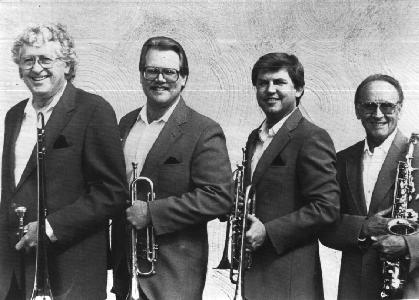
L to R:  Bob Flanigan, Mike Beisner, Greg Stegeman, Autie Goodman


AUTIE GOODMAN, now a fourteen-year veteran of the Freshmen, was the first to drop by.  He came to the group after a ten-year career with the Modernaires vocal quintet and work with the bands of Ray Eberle and Tex Beneke.  I asked Autie if the admiration for the Freshmen by The Beach Boys was mutual:

"I have two sons who were brought up in that era.  I hardly listen to anything but Nat Cole and jazz things.  I don't listen to any contemporary things at all.  I appreciate what they do, but i'm not interested in it because I was brought up in the era of jazz.and Charlie Parker and Dizzy Gillespie.

"I think the Beach Boys got their start by listening to Bob and the group.  They got their idea, and they put their own kind of modernization to it.  I think the Freshmen are the reason The Beach Boys got the way they are.  They put our sound to their style of music, and I think it's a marvelous tribute to Bob and the guys when they first started.  I wasn't with them then, but it's a tribute to them that they could be listened to and be copied by a contemporary group.  Also, Tony Butala of The Lettermen said they started out singing like the Freshmen before they got to be The Lettermen.   So a lot of contemporary people have adapted our style of singing to their own style, and it's a great tribute to the group.

"Bob used to do a put-on of "Surfer Girl" just to show that he could do it, but we've never done Beach Boys songs seriously.  We have to play to our fans, and besides it would be silly.  It would just sound like us doing their songs.  But if they've got something we could do, we sure would do it.  I'm sure Bob would like to do it."

According to Autie, the current Four Freshmen arrangements of "April in Paris" and "Li'l Darlin'" were taken from The Modernaires' book.  Presently Mike Beisner does nearly all the new arrangements for the Freshmen.  "I'm strictly a jazz musician.  I don't write any music.  I just sing it and play jazz saxophone."

GREG STEGEMAN looks to be going on twenty-eight, though he is actually forty and has had a long career in music since his mother gave him his first cornet.  Greg's discovery of The Four Freshmen came was when he was fifteen, and within a few years he acquired all their record albums.  A long stretch and many jobs later, he finally joined the group in August, 1989, ably filling in for the absent multi -instrumentalist Mike Beisner.

We began talking about Greg's skills as an arranger:

"I'm just starting to write for the group.  I've written in that style in the past, but the Four Freshmen library is so vast, and Mike is such an outstanding writer, that it's tough to squeeze one of my things in.  For a while we were doing my arrangement of "My One and Only Love," and "The Meaning of the Blues" is another thing I've brought into the group."

Greg agreed with me that the secret of Four Freshmen harmony lies in its inner voicing.  "Some day we'd like to record just the inner parts to see how they move.  It's all meant to create one sound.  Ideally, not one particular part is supposed to stick out.  The absence of vibrato allows the chords to really lock in."

Is Greg a Brian Wilson fan?  "I sure am.  In fact, given my age, when I was growing up The Beach Boys were the guys on the radio.  I had no idea who The Four Freshmen were.  That [was] something my parents had in their collection.  And then I realized that what I liked about The Beach Boys was their harmony, and indirectly they led me to the Freshmen.  In fact, on one of the early Beach Boys albums (Little Deuce Coupe) they did "A Young Man Is Gone," which was "Their Hearts Were Full of Spring" with different lyrics, as a tune about James Dean.  That knocked me out more than anything else.  That was my favorite Beach Boys song.  After I realized that was a Freshmen arrangement, the I knew I'd found my sound.  My parents had the original 5 Trombones album, and after that it was all over."  Greg also dug the Beach Boys' a cappella  on "The Lord's Prayer."


BOB FLANIGAN said he actually recalls meeting the young Brian Wilson.  "He was just a very young man with his family, and I wasn't really aware of who I was talking to--  Well, I was, but I didn't know what he would become.  Brian was the catalyst for that group.  He did the writing, the lead singing, and he was, for my money, the most important part of The Beach Boys in the early days.  It's just a shame that things went in the wrong direction for him for a period of time, because he's a very, very talented man, and the group has done some awfully good things.

"Of all the groups throughout the world that have copied The Four Freshmen, The Beach Boys are one of the very few who, when they do something of ours, always give us credit.  They say, 'This is something-- "Graduation Day," or whatever it might be-- 'This was recorded by The Four Freshmen.'  Which isn't necessary, but I think it's very nice."

Flanigan was recently honored by his hometown, Greencastle, Indiana.  It was a short trip from home to the Jordan College of Music in Indianapolis, where the Freshmen spent their formative years in 1948 and '49.  "When we first started singing, we had no arrangements.  We took each chord, and we harmonized it, the four of us, by ear and then remembered what we had done.  We listened to The Mel-Tones, a group that Mel Tormé had with Artie Shaw, and also The Pastels, who were with the Stan Kenton band.  They influenced us a lot.  But those early tunes were all done individually.  A guy would say, 'Let me try this part.'  That would work, and then someone else would say, 'I'll try this,' and so on.  We'd put those things together.

"We'd sound that way because we were always very influenced by the Stan Kenton band, and as we progressed musically we became even more so.  We always wanted to sound as much like the Kenton trombone section as you could sound, vocally.  Without Stan, in many ways, we wouldn't have lasted very long.  A lot of people think of us as like a sax section or a trumpet section or a trombone section.  Because we were all musicians, and everybody that's been in the group is a musician first and a singer second, we think like a section rather than a singing group.  That's one big difference between us and most of the groups."

Though The Four Freshmen started as a musical cooperative without a single arranging genius, Dick Reynolds stepped into the picture in 1951, while he was a trombonist-arranger with the Ray Anthony band in Hollywood.  "We were working in Jerry Wald's Studio Club.  The Anthony band was playing at the Hollywood Palladium, which was just half a block away, and guys would come in and have a drink.  We met Dick and became friends, but there was no thought of his writing for us at the time.  Then in 1955 we got the opportunity to do a song, "How Can I Tell Her," in a movie called Lucy Gallant.  Lee Gillette, our boss at Capitol, said, "You guys remember Dick Reynolds?  He's freelancing now in New York, and I think he's the guy that should write this arrangement.  So Dick came out to California and wrote the thing, we recorded it, and that was our first experience with Dick as an arranger.

"The association lasted until his death a couple of years ago.  In the beginning, Dick was not one of the big names in th business, although he was a great craftsman.  He did arrange many fine things for the Anthony band, like "Chattanooga Choo Choo," but nobody knew who he was.  When he started writing for us, we became his claim to fame.  Then he wrote for Roy Clark and The Beach Boys.  He wrote for everybody, including Lawrence Welk.  He could write anything, from charts for Welk to charts for the Kenton band.

"Over the years we've used a lot of different arrangers:  Dick Reynolds, Pete Rugolo, Nelson Riddle,  Billy May.  But by that time, we had established what The Four Freshmen were supposed to sound like.  And if you get an arranger of that caliber, they know what we're supposed to sound like.  There's no problem, go straight ahead.  They each add their own personal touch to it, which makes it still The Four Freshmen, but The Four Freshmen presented in many different. ways.


MIKE BEISNER is the youngest Freshman, though now a ten-year veteran with the group, discounting a hiatus in 1989-'90.   At the age of sixteen Mike filled a trumpet chair in Stan Kenton's orchestra, and by 1981, when Flanigan recruited him, he had mastered nearly the entire range of brass instruments.  When we started talking, Mike was discussing makes and models of flugelhorns and trombones with an admirer standing nearby.  I commented that he had contributed many arrangements to the current book, both vocal and instrumental.

"Oh yeah.  "April in Paris" is one of my charts, and the Ellington medleys one of mine.  "Li'l Darlin'" and several others are too.  "The Song Is You" is Kirk Marcy's arrangement; it's the only one he ever wrote, right before he left.  I don't think we ever performed that with Kirk.  Before joining The Four Freshmen, I had done a lot of writing for other people.  One of the first things I did for the Freshmen was the Ellington medley.***  When I joined the group there was another fellow named Ron Henley, who joined at the same time.  We were both horn players-slash-keyboard players.  The group had just scratched the surface of doing four-horn arrangements, and I saw all this brass sitting around and thought, "Why aren't we using all these horns?"  So I did some of the old tunes in the book, like "Angel Eyes," and started writing horn parts.  All the four-horn things we do, I wrote.


"Then I started working on the Ellington medley.  I had an idea for "Solitude" as an a cappella piece, and I sort of had the medley started.  It just evolved with different pieces, and it took quite a while.  I've been an Duke Ellington fan for years.  Duke used some voicing different from anybody else's.  On "Mood Indigo" he used a bass clarinet, muted trombone, and muted trumpet.  There's a lot of different colors.  That's what I enjoy most about Ellington's band.  You know, it wasn't the tightest band that ever worked, but it definitely had a life of its own, and I've always really liked that.  The voicing and the melodies that came out of Duke and Billy Strayhorn.  Classic stuff."

On Freshmen vocal arrangements:  "Maybe forty-three years ago, when they first started, nobody else had ever done that type of harmony.  You had your barber shop groups, where the melody or lead voice is in the middle the chord, with harmony on top and bottom, and there were other groups that maybe had two- or three-part harmony with simple, triad-like voicing."


***"Sophisticated Suite" can be heard on the groups's 1986 Pausa album, Fresh!

Here we were interrupted by another well-wisher, and by the time we resumed, the subject had changed to Mike's own path to The Four Freshmen:

"I was fourteen and taking private trumpet lessons from a teacher who had great ears and listened to the right stuff.  At that time I was listening to Al Hirt, Doc Severinsen, and those kinds of trumpeters.  This guy asked, 'Have you ever heard Maynard Ferguson, in the Stan Kenton band?'  I said, 'Well, I've heard the name, but I really don't know.'  'I've got a couple of albums you ought to hear.'  And he put on a piece Maynard recorded with Stan.  I heard this guy and said, 'That's just not possible on trumpet.'  It just blew me away.  Then he put on the Kenton set from the Road Show album, and my mind was made up:  If I had a big band, this is how I'd want it to sound.  And as I progressed as a trumpet player, that's how I wanted to sound, like Maynard in the '50s.

"Then he turned the record over, and this was my first introduction to the Freshmen.  'Who's that?'  'Well, that's a vocal group called The Four Freshmen.'  'Wow.  If I had a vocal group, that's how I'd want it to sound.'  So that was my eye-opening, awakening experience, in the same afternoon, to Maynard, the Kenton band, and The Four Freshmen.  This guy turned my head around for life."

The Four Freshmen, Mike told me, are on the road as much as 240 days a year, not counting the work they pick up working around their home base of Las Vegas, but there have bee some slack periods, such as the idle weeks of the recent Persian Gulf War.  Nevertheless, the Freshmen are now on salary out of Bob Flanigan's pocket, fifty-two weeks a year, whether of not there is work.  They generally use their off-time to rehearse and hone their sound.

ROSS BARBOUR, in his time the group's drummer, eventually stepped into the role of supplying comic patter between songs (much as Mike Love has functioned in The Beach Boys).  He seemed most gratified with the present festivities.  "Until now, we hadn't had seven Freshmen together in a room.  We have a reunion every year or so, but this is the largest gathering yet of the group itself."


"Sweet Lorraine"
     
Of his present life in Simi Valley:  "Kenny Albers  lives a couple of miles from me.  I see him once in a while.  He drives a limousine, and he never knows whether they're going to call him in the morning and say they need him at the airport immediately, and he's going to be there all day.  I do movie-extra work, where I get a call the evening before, saying, 'At seven in the morning, you've got to be at Pismo Beach,' or whatever.  With our silly schedules, we can't ever plan to go out for a beer.  We're not that organized."

Like Flanigan, Ross is fond of the memory of the group's early days at Jordan College at Thirteenth and Delaware in Indianapolis, which then consisted the William Henry Harrison home surrounded by quonset huts.  Like many others, the Freshmen attended college on the G.I. Bill:

"We owed a lot to that G.I. Bill.  Because what was the likelihood, first of all, that two brothers two years apart would be freshmen together in the same school, much less a cousin and Hal Kratzch, who was older?  I've said often that I think God is a Freshman fan:  He wanted to see what we were going to be able to do, and He kept making it possible.  He made it obvious to us, right there in school, when we started singing with this group and hearing these sounds.  It was the only thing we wanted to hear.  We disregarded our classes and made bad grades, all of us.

"Then, to be a professional musician was kind of a wild-eyed dream.  I was nineteen when we went on the road, so we didn't really have a developed life-ambition.  When Hal brought it up, we thought  well, it was something to do.  It was better than going back to college again.  And that's the choice we made.  It wasn't as though we were a group intent on making musical history and influencing vocal groups from then on.  We started out singing because we wanted to hear what we were going to sing.  We were singing things like nobody else had sung, and we wanted to hear it done.

"We each chose our own notes, and we met in a sort of committee:  'Is that the best chord we can get?  Let's try again.  You sing higher, I'll sing lower.'  Then on to the next chord of the song, and we'd meet on it in the same way.  Sometimes we almost came to blows:  'No, we should use a major seventh.'  'Man, then we won't have a ninth to that chord!'  Well, we'd finally get it settled, each chord solved by committee, really.  And when you've got an arrangement like "Now You Know" or "Poinciana," you've come up with something that other groups didn't take that much trouble to do.

"That was the way we developed the sound.  Later, of course, there were arrangers who wrote to make it like that.  But we were singing to please ourselves, and if the people liked it, that was okay, too.  We've got this sound we've got to develop, got to sing, got to pronounce.  Got to hear it.  What we were trying to do was a five-part vocal group with four guys and not a girl in it.  You have to leave out a note, and it has to be the correct note.  There are harmonics in people's ear that you don't have to sing.  First of all, you don't have to sing the bass note of the chord, because the bass is going to be playing that.  So that relieves one voice from the barbershop requirement of a single tonic.  And if you're playing the one and five-- the tonic and the fifth-- your ear accidentally hears the third, so you don't actually have to sing the third, unless you want that to be a pronounced note.  So you can sing the ninth, major seventh, whatever's up in there.  But you don't have to sing do and one of these obvious notes.  If you're singing do and a tenth one octave above, the five becomes what you hear in your ear.  So you can leave out certain notes in certain chords.  We just had to explore blindly:  How do you do this?  We weren't setting out to do this, thinking it through; we were hearing it through, trying to hit that chord we'd never heard a quartet sing before.

"So many of the groups had a lead voice in the middle and the other voices above or below.  Barbershop quartets are that way.  The Mills Brothers and a lot of other groups had the lead in the middle and harmony all around.  Well, we had a lead on top, and then spaced harmony notes below that.  We were blessed with Hal Kratzsh, who could sing clearly very low, and Bob Flanigan, who could sing clearly very high.  Don and I were left with the challenge to for in enough big, wide notes to fill, color the area between the two dimensions.  Those middle notes have to be big and round, and a lot of air to fill all the areas.  If you're singing like The Pied Pipers, you can play that chord they sing with just your right hand:  (sings) 'Dream when you're feeling blue...'  That's all one hand.  But the Freshmen stuff, you play over two octaves most of the time.  Oh, we'll close and then divide into duet, trio, and so on, but the sound people recognize is that five-part sound, where there's one note they're not hearing, and it's part of them.  It became a way of life for us.

"When you've got a blend and you've got the right notes, almost like they's got hooks on the sides of them, and  they hook together like a chain.  You can pull that chain as hard as you want, and that chord is going to ring with that tightness."

I said I thought it strange that four boys from Indiana wound up making a contribution to jazz, and Ross concurred.  "It is strange.  We were Kenton fans and Woody Herman fans, and of course Harry James and Artie Shaw and all the bands that played.  We'd heard The Mel-Tones sing with Mel Tormé and Artie Shaw, and we'd heard The Pastels singing with the Kenton band.  But they were five-part groups with a girl on top.  And for us to sound like them, we had to make some desperate effort to do without a fifth voice.  We never even hired a fifth voice or even discussed it.  Oh, in college we tried a girl."  Ross chuckled at the memory.

"We rehearsed and rehearsed a bunch of songs, and Hal had a friend at Indiana University who ran a band.  There was a dance down there, and the band needed a vocal group.  They called us, so we called the girl, 'Okay, we're going to Bloomington Saturday night, and we'll sing.  We'll probably be there until one, and we'll be back by two or three in the morning.'  'Oh, my mother won't let me do that.'  'Well, what have you been rehearsing with us for?  We've spent weeks!  '  We didn't have any girl after that."

On The Beach Boys:  "They listened to us, and I know Brian did a lot of studying of the Freshmen, especially of Bob.  Brian has pronounced that sound himself, trying to sing like Bob.  Bruce Johnston is a good man.  He's the only one in the group I really know, whom I've spent any time talking with.  We've seen the group and waved and shook hands, bumped into each other, but Bruce is the only one I've really talked to.  We saw them once in Salt Lake City, at a ballroom or in an amusement park.

"It's a shame that they aren't getting along now.  I know the Freshmen have had disagreements, but still we've been able to sustain our friendship."


SUNDAY MORNING CODA:  "I'M ALWAYS" CHASING RAINBOWS"

When I looked at my watch, it was past midnight, and I'd planned to leave early in the morning.   I said good night and thanks to John Banks and headed back to the Hilton.  After checking out Sunday morning I took a table in the hotel restaurant and ordered the All-American breakfast.  While wolfing it down, I heard Bob Flanigan's unmistakable voice rising above the crowd at the other end of the room, and when I finished I found him sitting in a booth, reminiscing with four or five friends.  They may have bee up schmoozing all night.

My presence reminded Bob of the put-on The Four Freshmen used to do with "Surfer Girl" (as they can be heard on their Live at Butler album from 1972, now on CD).  With a straight face he used to introduce the number with a very serious-sounding bit about how The Beach Boys had asked him to replace Brian Wilson.  One night Bruce Johnston was in the audience, and even he was taken in by Bob's b.s.

The more I thought of it, though, it didn't seem such a bad idea after all.

 IN ROTATION:

PIGGING OUT IN MADISON, early April, '21

  • Sun Ra and His Arkestra, To Those on Earth and Other Worlds (Strut, mid-1950s-mid 1980s)
This intriguing compilation, released in 2015, collects thirty-plus years of Sun Ra 's extensive recording career on two CDs.  It's the first compilation of its kind, I believe, and most of its 34 tracks are delights I'd never heard before; this compilation, moreover, would serve as a perfect enticement for the unenlightened to find the Sun.  Throughout, it is artfully arranged into a mosaic of Ra in his entirety.

With some exceptions, most of the selections have been previously released on Ra's albums and singles, mostly upon the El Saturn label, however rare.  Gilles Peterson, of the Strut label, wrote the album notes and produced the compilation.  Discographical information is as complete as possible.


To Those Of Earth And Other Worlds


  • Charlie Haden, Jim Hall, s/t (Impulse, 1990)
Charlie Haden - Jim Hall

A complete surprise to me and a  most worthy addition to the celebrated string of  live sessions Haden recorded regularly for the Canadian Broadcasting Corporation in 1989 and the '90s, heretofore on the Verve label as "The Montreal Tapes."  (An odd crew of industry bedfellows have participated in this release, the Universal Music Group and Impulse!_Records on the one hand, and Blue Note Records overseeing the disc's manufacture.)

A superb set of performances, this guitar/ bass pairing is as mutually simpatico a duet as I've ever heard.  No surprise:  Jim Hall was in attendance.

  • The Kinks, Arthur (Or the Decline and Fall of the British Empire)(Pye/ BMG/ abkco, 1969)
ΑɌΤΗՍɌ (2019 Deluxe 2CD Mediabook). UK Import

"Victoria"


"Lincoln County"

This double-CD set is not the most extravagant tribute to Arthur available (there's a lavish 4-CD box including both mono and stereo versions of the album, plus numerous other goodies)  but it suffices;  Disc One is dedicated to the album itself, in its stereo version, while Disc Two collects twelve stereo tracks from the late '60s and is subtitled "The Great Lost Dave Davies Album" (the booklet corrects several misattributions of authorship in prior releases).  Both discs are filled out with bonus tracks.


Now the album proper:  it's one of the finest Kinks albums, which is saying a lot.  The natural inclination was, and is, to compare it to Tommy, The Who's so-called rock opera.  That release, in a double-LP set, a misconceived epic about "that deaf, dumb, blind kid's" spiritual redemption, was a windy, overstuffed, gassy propaganda track for whoever Pete Townsend's guru at the time was. 

Not so Arthur.  Conceived as a soundtrack to a television production that was never completed, it tells the story of an ordinary Englishman who has survived both World Wars, the  Great Depression between them, and an unhappy present existence in his heavily mortgaged "Shangri-La."  Starting with the anthemic tribute to Victoria" and her empire where "the sun never sets," Ray Davies's lyrics do not spare the title character.    Arthur's God-and-country idealism is set against the brutality and cynicism of the politicians and military leaders who led an entire generation to the slaughter of war.  As the line goes in "Yes Sir, No Sir":

If the scum are going to make the bugger fight,
We'll be sure to have deserters shot on sight.
If he dies, we'll send a medal to his wife. 


Life in the UK grinds on through the Twentieth Century, and our ordinary hero chooses to ignore or explain away his servile predicament.  "Let all the Chinese and the Spanish do the fighting.  They'll never find us," goes the lyric to "Driving," as his family enjoys a picnic in the countryside.


This 2019 remastering is easily the best I've heard.

"Plasticman" in stereo


  • Otis Redding, The Dock of the Bay (Atco, 1968)
Dock Of The Bay by Otis Redding (2009-12-08)

Cropper, "Duck" Dunn, etc.  I love Otis, but except for the title track, I've never heard any of this before.  A joyous statement to mark the shortening of a talented life.


  • The Dave Brubeck Quartet, Time Further Out (Columbia, 1961)
Brubeck was an early idol of mine, all the way back to the days Indianapolis radio jock Jim Shelton used the oddly attractive "Take Five" to introduce his "Platter Party" rock 'n' roll program on WIBC each afternoon.  (In those days 'IBC was an AM station.)

This 1961 followup to the wildly popular Time Out in 1959 brings the same personnel to another clever and attractive round of unusual and contrasting time-signatures, fine stuff all around.  I still fondly remember such tunes as "It's a Raggy Waltz" and "Unsquare Dance" from my long-ago salad days. 

Time Further Out

" Unsquare Dance" 


PIGGING OUT SIMULTANEOUSLY at Amazon

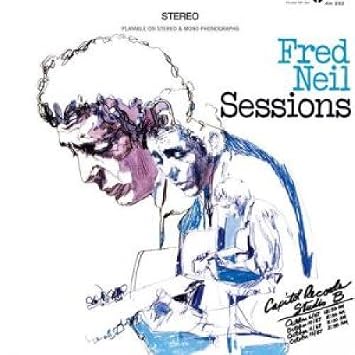
  • Fred Neil, Sessions (Capitol, 1968) CD reissue
Fred Neil - Sessions - Amazon.com Music
"Send Me Somebody to Love"

 Sessions was my first Fred Neil album, snatched up the year it was released.  For its time, it followed the radical concept of creating an album mainly of loose, all-out jamming by Neil and his cohort of studio pros, as if the audience were a fly-on-the-wall observer of the performances, warts and all.  The only precedent to this kind of "concept" album I can recall was The Beach Boys Party album in 1965, although that "party" atmosphere was a carefully constructed fake.

For many years it has bothered me that the Sessions tracks contained on the otherwise-unbeatable Collector's Choice two-disc compilation The Many Sides of Fred Neil from 1998 contained an inferior take of the album's opening track, Neil's "Felicity."  It used instead a shorter, less interesting take featured on another Neil album, Other Side of This Life.  I just had to have the real thing, so I arrived eventually at this pristine CD reissue.

Other than the first two or three tracks, it requires a degree of patience to listen through a presentation of this sort, well-edited though it is.  The lyrics to "Merry Go Round" are deep ("Where's the Jim Crow section of your merry-go-round?/ I just can't find the back," and I always feel the same thrill as the band after their finish of "Looks Like Rain";  "Wheeee!  Fly United!"


This set is a splurge, but I had to have it:  Miles Davis's complete Newport Jazz Festival performances from 1955, 1966 and '67, 1971, 1973, and 1975, spread over four discs.


Miles at Newport, 1955


NEXT: Kimson Plaut

Saturday, March 27, 2021

Sweet Insanity


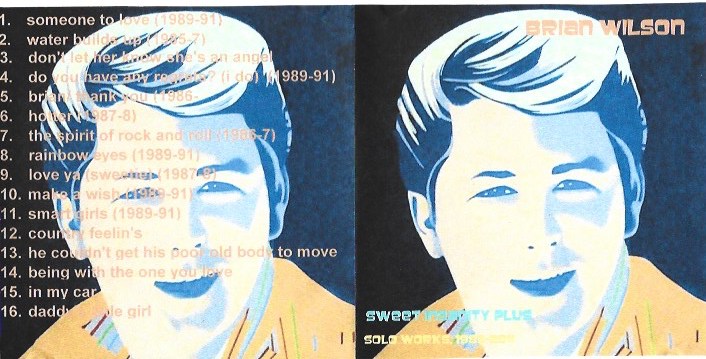
  • Brian Wilson, Sweet Insanity: from the original cassette version submitted to Sire Records by Dr. Landy in 1990. 


Some new thoughts on a lost Brian Wilson album.

Two segments from the "official" ESQ video of the Beach Boys Fan Convention in San Diego, August 1990.  ABOVE:  Brian Wilson performs at the piano for an audience of perhaps 300.  (My brother and I are prominent in the reverse-angle shots from behind the piano, over Brian's left shoulder.). BELOW:  Brian, Gene Landy & Co. at the Hard Rock Cafe downtown, after the fan convention.


Sweet Insanity, as a bootleg release-- I got mine on downloads-- came in two versions:  the first included more songs, but the other had superior sound quality.   Of the ten cuts (plus five extraneous tracks on my copy), four-- "Make a Wish," "Don't Let Her Know She's an Angel," "Rainbow Eyes," and "Let's Stick Together (outfitted with new lyrics by Van Dyke Parks and retitled "The Waltz") went on to "official" release in new versions on Gettin' In Over My Head in 2004.  The original versions, however, were superior to the issued ones.


IN ROTATION:

To repeat myself from a prior post:  Beyond any doubt, Orange Crate Art is the single best release of 1995.  As one would expect, Van Dyke Parks's instrumental arrangements are lush and Wilson's multitracked vocals, arranged also by Parks (though they fit Wilson's voice as well as if he himself had done the charts) are some of the best of his later career.  (Why did Parks enlist Wilson for the vocals?  "Because I can't stand the sound of my own voice," he once explained.) All of the tracks are little marvels, from the opening title track through the instrumental "Lullaby" by George Gershwin, but my favorites are the loping-along Western epic "San Francisco" and the nostalgic "Turn Back Time," which manages to do just that with a magnificent harmonic shift in its chorus.  The majority of the songs celebrate the same California settings that are depicted in the package's artwork.


What a wonderful world...


Brian Wilson & Van Dyke Parks prep expanded 'Orange Crate Art' reissue,  share new video


  • Kenny Dorham, Quiet Kenny (Riverside, 1951)

Quite possibly the best of KD.

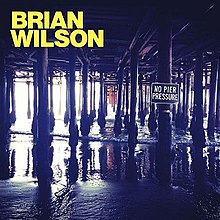
  • Brian Wilson, No Pier Pressure (Brimel/ Capitol, 2015)
My first real hearing in the nearly seven years itr's been out. 


No Pier Pressure.jpg


NEXT: The Four Freshmen


Tuesday, March 2, 2021

Brian Wilson Exclusive

I was fortunate to attend and record a talent-packed songwriter's conclave at the Will Geer Arboretum, in Topanga Canyon, Los Angeles, in June of '96 (out west to commemorate my mom's 75th birthday two days later).

After several false starts, I finally learned how to upload this video to the blog, a major achievement from an alter cocker.  Please enjoy it here,  in four parts: 


IN ROTATION:

Vinyl mania!


  • Duke Ellington, "Retrospection," "Nobody Was Lookin'" b/w "Afro-Bossa Piano Summations (D.E.T.S., 1962, 1964)  Jerry Valbern, Duke Ellington Study Group Convention, Detroit, May 16-17, 1984


  • Duke Ellington, Treasury Series No.  (D.E.T.S. LP, 1945)
Complete Script:

Sides A and B:  Olympic OL-7129 (E)


Lightly and Politely


Lightly and politely

another batch from LCPL:


It's hard to overstate my esteem for this peerless musician, one of whom I was aware early on but came to really appreciate much later, thanks to the person on the Duke-LYM list who recommended Water from an Ancient Well.  What a long, distinguished discography Ibrahim has given us.  I greatly regret never having had the pleasure of hearing him in concert and the decreasing possibility that it will ever happen.

This 2019 release (his next to last) is extraordinary in itself.  Ibrahim's longstanding ensemble Ekaya, which together with the leader formed a nonet of five reeds and winds, one trombone, and three rhythm to produce a sound unique unto itself, however personnel have varied over many years.  I don't recognize the names of any of the sidemen on this recording, though I surely expect to do so in the future.


  • Larry Coryell and The Eleventh House, Seven Secrets (Savoy, 2017)


  • Sonny Rollins, Road Shows Vol. 4:  Holding the Stage (Sony/ Doxy/ OKeh, 1979-2012)  released 2016;  various live performances from Europe and America


  • Lennie Tristano, Chicago April 1951, Uptown)


  • Paul Bley, Gary Peackock, and Paul Motian, When Will the Blues Leave (ECM, ????)


NEXT:  Sweet Insanity