Search This Blog

Friday, December 18, 2020

The "Root of Evil" in The Pardoner's Tale

This being December of a presidential election year, only weeks prior to the departure of the present Administration, the subject of official pardons (many sold for cold cash, without doubt) has become particularly pertinent.  My undergraduate take on Chaucer and his  "Pardoner's Tale" thus takes on new relevance.

Paul Strohm: Chaucer's Tale (2015) - Folgerpedia

Paul Strohm

My original MS is dated May 1, 1968, for L219 Prof. Anderson, but I'm quite certain I submitted it first to Dr. Paul Strohm, with whom I was able to stay in touch for some years, particularly to express our mutual enthusiasm for the works Thomas Pynchon.  Since the last time we saw each other at IU's Ballentine Hall or his off-campus apartment, I now read that Prof. Strohm has risen to dizzying heights in the academic world:  a long stint at the University of Oxford, and at present a chair at Columbia in New York.  I'm set to read his recent essay, "The Man Who Insulted Shakespeare."

A work of pure imagination.

I wonder what Paul  (not to mention Pynchon) is up to these days?


Portrait of Geoffrey Chaucer (4671380) (cropped) 02.jpg


"Radix malorum est cupiditas," proclaims the Pardoner at the beginning of each of his sermons: avarice is the root of evil.  But in an even larger sense than the Pardoner's sententious and cynically loaded references to avarice imply, the tale raises the question of the "root of evil" in a world which God called good at its creation.  The Pardoner suggests that it is avarice and its-- and its counterparts glotonye, luxure, and hasardrye-- which is responsible, ultimately, for the sin of the world, and this explanation suffices in a cursory interpretation of his tale.    Yet such an analysis seems to do no justice at all to the question posed by the tale and invites a deeper inquiry as to the significance of avarice and the location of evil within (and without) the context of the tale.

The Pardoner founds the substance of his sermon on this paradox of evil, the ironic ingratitude of man:

Allas, mankinde, how it may bitide

That to thy Creatour which that thee wrought,

And with his precious herte blood thee bought,

Thou art so fals and so unkind, allas.

(11. 572-5)

From this fundamental irony grows a multitude of smaller and more complex ironies.  Not only the mechanism, but also the very substance and the surrounding context of "The Pardoner's Tale" is an artfully compounded irony and paradox:  the Personification/ super naturalization of Death, the juxtaposition of the revelers and the old man, the significance and poignancy of everyday remarks, and, behind the scenes as it were, the Pardoner himself providing the living exemplum of avarice by manipulating the Christian desire for salvation to serve his pocket, using every sordid trick of his trade to prove that even a hypocrite-- again ironically-- can practice precisely what he preaches.  The magnificently vital (and highly familiar) harangue against the sins of gluttony, lechery, and gambling is but a skillful ploy to gain our money.  It is indeed avarice that provides the undoing of the Pardoner himself, as well as his three revelers, as it is specifically their unbridled greed which causes them to to pervert their respective moral missions, forget their respective susceptibility to sin and moral ruin, and meet destruction.  The key episode in the tale of the revelers is the encounter with the old man, who himself seeks Death and realizes that sin and death come fully only to those who are unmindful of its omnipresence and who expect it least.  Thus are the revelers led to forget their mission to destroy Death, and it is avarice that reverses the situation and pays them all in kind.

But it is this same episode with the old man that leads us to suspect that it is something other-- or, rather, something more-- than mere avarice that is responsible for the mind of the sinner and is, hence, the catalyst of his undoing.  The old man recognizes something more than avarice in the revelers, something more explicitly integral to their nature, and that is the arrogance of their youth out of which they mock and humiliate him.  Tho old man sees this arrogance, this pride, as the source of man's potential for sin:

But sires, to you it is no curteisye

To spaken to an old man vilainye

But he trespass in word or elles in deede.

In Holy Writ ye may yourself wel rede,

"Agains an old man, hoor upon his heed,

Ye shal arise."  Wherefore I yive you reed,

Ne dooth unto an old man noon harm now,

Namore than that ye wolde men dide to you

In age, if that ye so longe abide.

And God be with you wher ye go or ride:

I moot go thider as I have to go.

            (11. 411-21)

 This pride, of course, is more than the rudeness youth shows to age.  It appeared earlier in the tale in the manner of one of the revelers toward his servants, and in fact pervades the entire attitude of the revelers toward the Death they seek to kill; their pride makes them incapable of conceiving of Death as anything greater than a neighborhood bully who deserves a thrashing.  And while the object of setting out to rid the world of death is a noble idea derived from an essentially Christian sentiment, it is also as arrogant as it is ignorant of the power of Death and the fallibility of man.

Thus it is a kind of hubris that leads the revelers to their destruction; indeed, had their motives been higher, their station more exalted, and their perception greater, they might have been participants in a tragedy à la Oedipus, instead of a mere exemplum of the sin of avarice.  Avarice, within and without the tale, is indeed a sin; that is to say it is a result, an end-product of the flaw in human nature which permits man to sin.  The Pardoner's Tale locates this flaw in man's pride, his proneness to overextend himself, his tendency to challenge those those things (e.g. Death) which are beyond challenge.  In the same vein, the Pardoner exhibits pride in his cynical attitude toward both his subject and his listeners, the attitude that he alone is immune to punishment for the same sin he would have others eschew.  Chaucer's epilogue to the tale gives us the satisfaction of seeing the Pardoner cut down to size.  

  IN ROTATION

Voz e Violão
Gil Luminoso cover.jpg
JoaoVozeViolao.jpg


Lightly and Politely


 CosmicTones.jpg


NEXT:  Lenny Bruce


Friday, November 6, 2020

Fall Breaks And Back To Winter

NB:  Copying an old manuscript is so much easier than actually writing fresh stuff.  Most of the text that follows was published originally under the title "THE WONDERFUL RESURRECTION AND TRANSFIGURATION OF SMILEY WILSON" by ESQ in May, 1988.  Coincidentally, I do have another ms. titled "Fall Breaks..." on another topic entirely.  A dilemma wrapped in an enigma, etc.

It reveals an author who was snarky, precious, and without doubt completely stoned at the time of writing.   More than twenty years later, I reread it with some irony.)
This 2011 CD remaster comes in a cardboard sleeve.    The first eleven tracks display the original monaural version of the album; the following eleven are in true stereo.  Because of the circumstances surrounding the master recording of "Good Vibrations," a digital-electronic trick had to be played to obtain a stereo version.


I've never quite understood the carpers who write about Smiley Smile as if it were a piece of shit.  Yes, I too was disappointed when it first came out in 1967, especially in the light of Jules Siegel's article in Cheetah ("Goodbye Surfing, Hello God").  Nobody, of course, has any problem with "Good Vibrations" or "Heroes and Villains."  But it has taken me twenty-one years to catch up to and begin to understand most of the rest.

Jules Siegel


The first thing I came to realize is that the album's primitivism (compared to the group's prior work and the contemporaneous music of George Martin's clever lads) was its response to the dizzying gyrations of the mid-Sixties scene.  It reflects, moreover, the protracted identity crisis of the Beach Boys, tearing their sound down to an essence and recombining it on a plane altogether the antithesis of all that went before, particularly the baroque confection/ confession that was  Pet Sounds.  But in 1967, on first listening to shards of "Fall Breaks and Back to Winter," "Little Pad," and "Gettin' Hungry" in the dorm (this was the summer of Jimi Hendrix and the rest of those mostly-boring San Francisco acid heads), you mainly felt the pain of its creator, Brian Wilson, picking up the cross he would carry for the rest of his life.

Siegel's aforementioned account, along with nearly everything else devoted to the SMiLE, period, laments what we never had heard, the legendary tracks across the prairies and up to the stars, the album started out to be.  Many years ago, I received a cassette from my little brother on the west coast.  It turned out to be the first installment of a yardstick with which to compare to the album that finally appeared in the fall of 1967.   The tape, a fifteenth-generation dub by the sound of it, included about forty-five minutes of karmic redemption, with stuff I'd never heard before, labelled "Barnyard," "Do You Like Worms," "Can't Wait Too Long" (straight from the heart of Jesus), "The Old Master Painter," "Tones," "Bicycle Rider," and the flaming "Mrs. O'Leary's Cow," coming at me like Beelzebub himself.  Including some of the few genuine SMiLE pieces to emerge in the late '60s, different and/ or incomplete verstions of "Surf's Up," "Good Vibrations," "Cabinessence/ The Iron Horse, Grand Coulee Dam," "OurPrayer," "Child Is Father of the Man," and "Wonderful."


This last tune, in its first-released version is more than a remarkable work of art and must be singled out for special attention.  Surely, it should be our national anthem.

On Smiley Smile, the tune features one of the most appealing and revealing combinations of melody and lyric ever to appear on a Beach Boys record.  The span of this song, an entire lifetime, gives at the same time a mere "day in the life":

She belongs there left with her liberty,

Never known as a non-believer.

She laughs and stays in the

Wah, wah, Wonderful.

All of Carl's vocal  proceeds above a bed of childhood noises, toys, etc., as does the following:

She knew how to gather the forest when

 God reached softly and moved her body.

One golden locket, quite young,

And loving her mother

And father.


Farther down the path was a mystery,

Through the recess, the chalk and numbers,

A boy bumped into her

Won, won, won Wonderful.

Na na na na na


Now comes the insert:  the disarming simplicity of Carl's voice against a cracked piano and muted harmonica gives way to a few bars of jazzy doo-wop-- actually taken from one of SMiLE's versions of "Vegetables"-- led by Mike's "hey poppa rebop" scat riff, suggesting all the righteous joy of our lifetimes.

After a chorus of this, we are returned to Carl's voice and the ontological liberty with which the song begins:


She'll return in love with her liberty

Never known as a non-believer.

She'll smile and thank God for

One, one, one Wonderful.


This is the sort of song-- a kind of androgynous poppa mom mow mow OM, mind you-- that changed the course of my life and, in the lingo of my onetime roommate Bloy, an axis mundi that one could fight and die for.  We lit another nutmeg cigarette as "Whistle In" whisked us to the exit groove and speculated upon the dumb and the brilliant, the sacred and profane.

Flash forward to my first hearing of the original SMILE version in 1986:  picture an embittered old fart, fat and married, oppressed by seeing trampled everything he loves and respects in this world* and wondering whether, indeed, he will live to see the Revolution.  He slips this cassette into his AKai CS-797D, little knowing he is about to experience the Second Coming.  "Wonderful" arrives on the heels of "Our Prayer," but gone is the childlike simplicity of the Smiley Smile arrangement.  The stentorian bass tones of a harpsichord introduce the more urgent voice of Brian and are answered, as in a Bach fugue, by another harpsichord and flugelhorn in counterpoint.  The pastoral elegy of the released version now, suddenly and unexpectedly, darkens into a narrative of sin and redemption.  After "A boy bumped into her..." there is no longer the cosmic rave-up the old fart has replayed since the summer days (and summer nights!!!) of virginity.  There is, instead, a new fourth chorus and a significantly different final chorus:


"Heroes and Villains"


Brian raps about Smiley Smile


"Fall Breaks and Back to Winter"

All fall down and lost in the mystery

 Lost it all to a non-believer,

And all that's left is a girl

Who's loved by her mother and father.


She'll return in love with the liberty

Just away from the non-believer.

She'll sigh and thank God for

One, one, one Wonderful.


"She'll sigh and thank God... "  Brian isn't very smiley here in the original version.  The song, no longer in love with the liberty, is consumed by the mystery, but Brian promises to return.  He is, for now, on the dark side of the moon; yes, there is another side to this life.

Suddenly, apparently from about the early 1980s, there has been an explosion of bootlegged Beach Boys material, ranging from uncatalogued demos pirated from Brother Records to completed album-length unreleases.  How much SMiLE is potentially out there has been estimated many times over the years, by Brad Elliot, Domenic Priore, and others, but very little of it has been in circulation, and some of it may have been destroyed.  (There is at least one bootleg LP-- "Brother ST2580, but alas, it doesn't include the mind-bending version of "Wonderful."  However, it does have a more finished version of "... Worms"/ "Bicycle Rider" and two additional tracks, the stately brass chorale "Holidays" and the humorous brass conversation called "George Fell Into His French Horn,"a sort of updated "Our Favorite Recording Sessions."


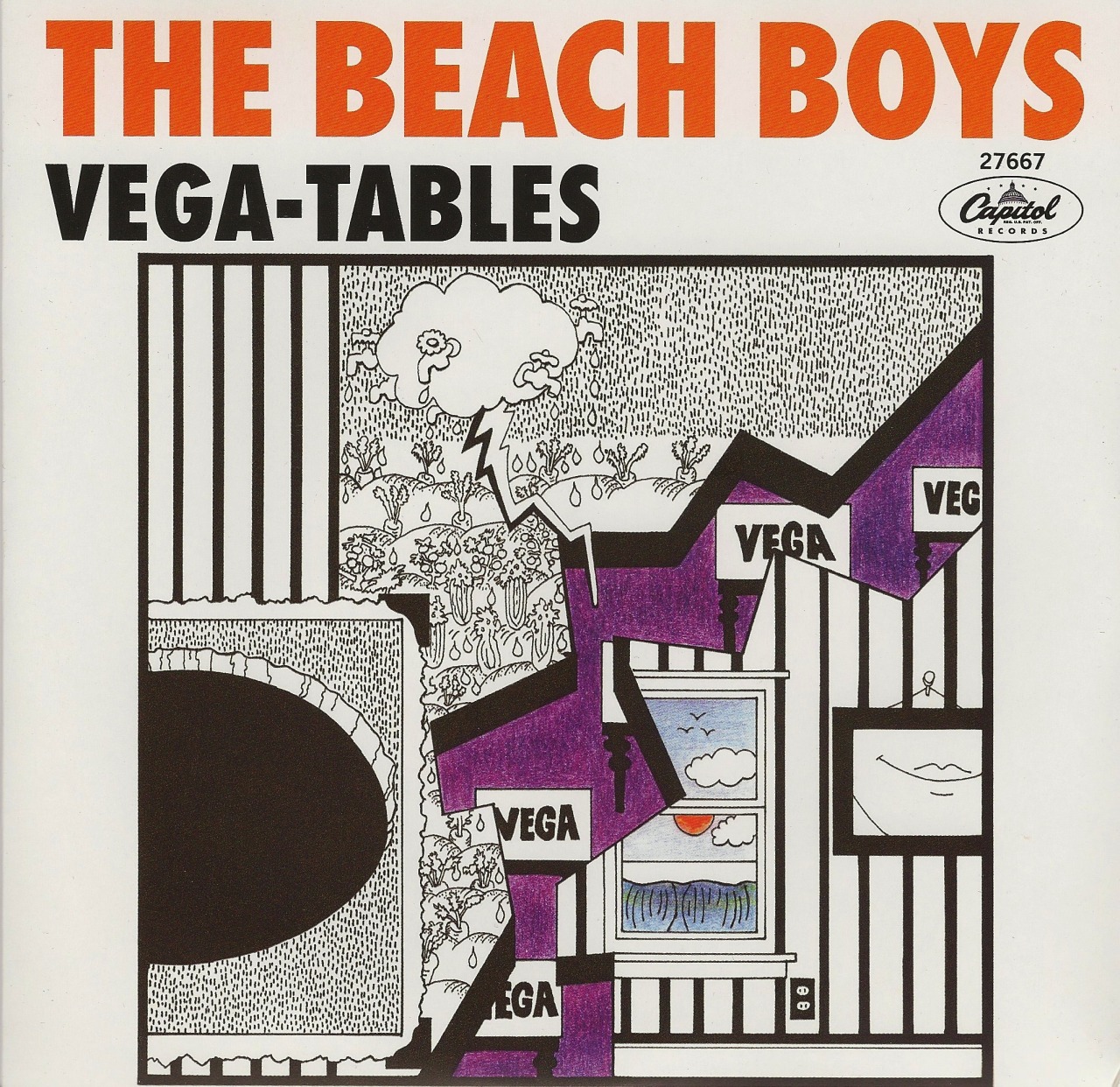
"Vegetables"


Now comes the big news:  Rick Edgil swears to God that I can die happy at last.  Brian Wilson himself, not content with recording "Love and Mercy," is going to smile once more alongside Van Dyke Parks:  their album is scheduled for release this year.  What should be the final product be like to match our dreams?  The possibilities are stretched between issuing a session-by-session SMiLE of all existing tapes (the collector's Nirvana, but not likely from a commercial point of view) and the staggering thought that Brian may really complete the damned thing at last, having achieved the liberty to solve the mystery, so to speak.

Brian could not fail us twice, in two successive incarnations, could he?  Only one thing is certain:  people will still go on bitching about Smiley Smile.  Brian, forgive them; they don't know what they're doing.***

NOTES:

* All the more so in 2020.

** Not until three years later would Wilson and Van Dyke begin their project at all.  The result was Orange Crate Art in 1995.

*** Brian released a solo CD in 2004, Brian Wilson Presents SMiLE, and in 2011 Capitol Records released its mammoth box set, The SMiLE Sessions.


**** I am nearly certain I was stoned when I first wrote this piece.  I am quite certain I was when I revised it.


IN ROTATION:


A brief Miles Davis tour.....


What the hell happened to Volume 1?  It's a long story.


NEXT:  Chaucer's "Pardoner's Tale"


Tuesday, October 20, 2020

The Yiddish Question in the Twenty-First Century

Winter, 1991

How To Talk About Lenny Bruce And Influence People | scoopsmentalpropaganda


 While reading Baugh and Cable's History of the English Language, I was both surprised and a little annoyed to find no mention of the Yiddish language in either of the two places I had expected to find it.  I searched the first chapter for the relationship of Yiddish to the Indo-European family of languages, which has since medieval times shaped and nurtured it; I perused the final chapter on the development of American English, hoping to find at least a word on the impact of Yiddish.  Both times I came up empty, and my conclusion is that Yiddish is difficult to classify and subtle in its influence upon American English.

My own knowledge of Yiddish has never been extensive, though I grew up in proximity to Yiddish speakers.  I remember hearing from my parents such choice tidbits as "Gei kochen ahfen yom," "Is nisht gefiddelt," "A kocher nemt a pisher," and "Ich hab dir in bud," but only later came to realize how much of it was obscene.  My parents, both first-generation American-born Jews who ordinarily used garden-variety midwestern American English, used Yiddish as a code that their children could not understand, so we picked it up only in dribs and drabs.

My mother's parents, however, brought Yiddish with them from Europe as their primary language, though both of them could speak Russian and became proficient in English.  My grandmother would sit at her kitchen table, sipping her tea through a sugar cube as in the Old Country, reading her copy of Vorwarts with column upon column of strange Hebraic characters without vowels.

For second-generation American Jews such as myself, religious education was in Hebrew, not in Yiddish.  Hebrew, moreover, was the revived language of the modern state of Israel, while Yiddish appeared to be an idiosyncratic expression of survivors of the European shtetl and ghetto.  Clearly, there was a generational pattern at work pertaining to Yiddish in America.

Jane Eisner on US politics - Saturday Extra - ABC Radio National

Perhaps the major reason for the reluctance of our textbook authors to discuss Yiddish is that it appears to be a linguistic and historical anomaly.  It did not receive its distinctive characteristics before the eleventh century, when Jews were invited from the Rhineland to Poland and Russia as a merchant class in between the nobles and the serfs.  Yiddish developed as a peculiar amalgam of Indo-European and Semitic languages, Hebrew ion its orthography, Low German in much of its vocabulary and syntax, with a leavening of Hebrew and Aramaic from the Scriptures and Talmud, and later a heavy overlay of Slavic and a few Romance elements.  Until quite recently, it was regarded as essentially a folk-tongue without a written grammar and a language that seemed to defy strict grammatical analysis.

Over the centuries between the Middle Ages and the Second World War, Yiddish produced a very rich literature of folksongs, tales, and folklore.  German-Jewish literature, except for the Hebrew lettering, differed little from its gentile milieu, unlike its counterpart in Poland and points east.  It was the spoken language of the masses of European Jewry up until the Holocaust, surviving even the Haskalah, the mass enlightenment movement of the late nineteenth century led by Moses Mendelssohn, which translated modern European literature into Yiddish.  The 1860s and '70s brought a temporary decline of Yiddish, as Russian schools and culture were opened to Jews, but by the 1880s Russian pogroms facilitated its revival.  The flowering of Yiddish literature, in both Europe and America, took place in the late nineteenth and early twentieth centuries.  The Yiddish theater, influenced by the works of Tolstoy, Turgenev, Dostoyevsky, and Chekhov, likewise flourished for many years.


The nemesis of Yiddish language and culture, particularly in America, has been the acceleration assimilation of Jews into the mainstream of modern secular society.  Aside from the shrinking immigrant generation served by the Vorwarts, the chief medium for the transmission of Yiddish language in America has been show business, particularly the work of Jewish stand-up comedians of the second or third American-born generation.  Through them there has come about in this country a hybrid, which some have dubbed "Yinglish," wherein the expressiveness of the Yiddish language is used to pepper English for mass-media consumption.  It is primarily through show-business usage that some five hundred Yiddish expressions-- such terms as schmaltz, goyish, and goniff  have entered the English language and earned listings in the Oxford English Dictionary.  Ironically, many of the individuals who helped familiarize America with such Yiddishisms, such as the comic Lenny Bruce, learned them only at second-hand and used them onstage in place of taboo English expressions.


The decline of the Yiddish language has occupied the past half century and has inspired clamorous debate in Jewish publications for at least that long.  Between the large-scale emigration of surviving European Jews to Israel and the ongoing process of assimilation, the question has often been posed whether the end of Yiddish as a living language might mean as well, the disappearance of the Jewish people, at least if we define "Jewish" in terms of the traditional lore of Judaism accumulated during the past millennium.  Efforts are ongoing in many parts of the world to preserve the literature and traditions of Yiddish for the generations to come, but the time seems to have passed when anyone can seriously expect Yiddish to occupy the place it once did in Jewish life.  It may well be that whatever Yiddish is heard on a mass scale in the next century will be understood because of its present penetration into English.

Thank you, Lenny Bruce.

BIBLIOGRAPHY

Birnbaum, Solomon A.  Yiddish:  A Survey and a Grammar.  Toronto:  U of Toronto P, 1979.

Fishman, Joshua A.  Yiddish in America:  Socio-Linguistic Description and Analysis.  Bloomington:                       Indiana U P, 1965.

-------, ed.  Never Say Die!  A Thousand Years of Yiddish in Jewish Life and Letters.  The Hague:  Mouton, 1981.

Kogos, Fred.  A Dictionary of Yiddish Slang and Idioms.  New York:  Citadel, 1966.

Rosenbaum, Samuel.  A Yiddish Word Book for English-Speaking People.  New York:  Van Nostrand, 1978.

Samuel, Maurice.  In Praise of Yiddish.  New York:  Cowles, 1971.

Turan, Kenneth.  "They Told Me That Yiddish Was a Dead Language," Smithsonian 21: 10 (January 1991), 60-71.

IN ROTATION:

Introducing Carl Perkins.jpg

My interest in the L.A. pianist  Carl Perkins began with the WBEZ-Chicago broadcasts of jazz d.j. Dick Buckley back in the 1990s.  Buckley, a native of Indiana himself, used to recall the times he heard Perkins play in his own hometown, Indianapolis, and eventually fulfilled my request to hear him play this album in its entirety.

Perkins died of a heroin overdose at the age of 29, and Introducing, from February 1956, turned out to be his only recording as a leader (discography).  Here he is joined by his Indianapolis homey, bassist Leroy Vinnegar and the lifelong Los Angeles drummer Larance Marable.  Of the eleven tunes on the record, six are popular standards and the remaining five Perkins originals:  "Way  Cross Town" (later renamed "Mia"); "Marblehead,"a relaxed blues; "Westside," another blues, uptempo; "Why Do I Care," a brisk and memorable AABA tune that effectively employs block chords; and "Carl's Blues," at a bright, medium tempo, probably his best-known composition.  On ballads ("You Don't Know What Love Is," "It Could Happen to You"), Perkins usually takes a dreamy, rhapsodic approach modeled on Bud Powell's and Erroll Garner's, but generally a bit faster and with more swing.

It is a pity that Perkins's work both here and under the leadership of a who's who of other musicians,  is not better known and appreciated, not to mention that his name is often mistaken for that of the rockabilly writer of "Blue Suede Shoes."

Perkins's odd posture at the keyboard, using his left hand and elbow in a crablike fashion, has often been remarked upon.  I wish I'd been around to see him play in person.

A more recent CD release on the Phono label includes an additional eleven additional tracks from sessions recorded in 1954 and 1957, plus an informative booklet.  There are four unaccompanied solo performances of standards and and a selection of tracks Perkins recorded as a sideman with Oscar Moore and Jim Hall.  


Captain Beefheart - Lick My Decals Off, Baby.jpg

I seldom play this album, though it is often praised.  The title track is mesmerizing; hardly a day goes by without my humming the guitar line or mouthing the lyrics.  Most of the rest bores me, especially compared to Beef's immediately previous release, the double LP Trout Mask Replica.  But "Space Age Couple" ("whyn't you flex your magic muscle") has become one of my mantras.  A few of the tunes seem just plain silly, but all the instrumentals are good.

Here's another record I've neglected for quite some time, having had nothing but a needle-drop CDR to listen to. but hearing at last the actual CD in all its glory,  I have a new appreciation for it.  The Kinks' lineup included, besides the Davies brothers, John Gosling on keyboards, John Dalton on bass, and longtime drummer Mick Avory.  The liner notes inform that Ray and Dave were able to maintain some brotherly harmony through the recording sessions, and it shows here.

Schoolboys is a kind of prequel to the Preservation dramas from a few years back, with the principal characters being young versions of themselves.  Unlike some of that, this album stands well on its own, without a narrator, because of the strength of its songs.  "Education" has possibly Ray's finest vocal performance and a female chorus well used.  "The Hard Way" is introduced by Gosling's piano solo, almost a sublime moment itself.  "No More Looking Back," a perennial theme for the group, is perhaps the album's finest track, boosted by Ray's cherished horn section.

KinksSchoolboysinDisgrace.jpg


This recent double-CD release is an important find.  This performance took place on June 23, 1958,  at Gene Norman's Crescendo nightclub in Hollywood.  


  • Ari Barroso, ???? (???, 1930-1942)


Lightly and Politely


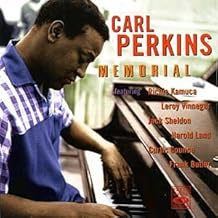
Carl Perkins Memorial

  • Carl Perkins, Memorial (Fresh Sound, 1956, 1957)
Pianist Perkins could boast a huge discography as a sideman, but only one studio album and a handful of singles under his own name.   This release is a welcome addition to that discography in the form of excerpts from three Los Angeles television appearances, most from the KABC Stars of Jazz series popular in the late '50s.  Perkins appears here as sideman to the Leroy Vinnegar Quartet, the Herbie Mann Quartet, and the Curtis Counce Quintet, wherein he participated memorably in studio sessions for the Contemporary label, as well.  Short as they are, these selections nevertheless provided ample opportunity to strut his stuff.

  • Tokishko Akiyoshi, Toshike Mariano Quartet (Candid, 1960)

Toshiko Mariano Quartet by Toshiko Mariano Quartet (Album, Hard Bop):  Reviews, Ratings, Credits, Song list - Rate Your Music


  • Toshiko Akiyoshi Jazz Orchestra, Featuring Lew Tabackin, Desert Lady/ Fantasy (Columbia, 1993)
Toshiko Akiyoshi Jazz Orchestra - Desert Lady / Fantasy (1994, CD) | Discogs


  • The Beach Boys, The SMiLE Sessions:  vinyl excerpts (Capitol, 2011)
The Beach Boys - Heroes And Villains / You're Welcome (1967, Vinyl) |  Discogs

Toilet Paper Cosmos — The Beach Boys “Vege-tables” single artwork by...

The Adventurers Club: The Beach Boys - Vegetables


Re-Entry by Horace Silver


In Paris by Sims, Zoot (1995-05-23)


Gimme A Holler

  • Nara Leão,  Pure Bossa Nova:  A View on the Music of Nara Leão (Verve/ Phillips, 1967, 1971, 1984)
Pure Bossa Nova


Art Blakey and the "Jazz Messengers": Live [ LP Vinyl ] - Amazon.com Music


NEXT:  Smiley Smile 


Friday, October 2, 2020

Raising Caine

 WINTER, 1991


Truth to tell, there really is no romantic, exotic history behind Caine, no illustrious pedigree which I might claim.   When people occasionally ask whether I am related to the British actor Michael Caine, I tell them that he's the one with all the money, but the fact is neither of us received the name Caine at birth.  The famous Caine was born with the name Mickelwhite in a Cockney slum, while I was born Daniel Cohen in Indianapolis in the year 1948.  In my own opinion, the idea of the name change, which took place when I was less than a year old, was a consequence of the fact that persons with Jewish surnames were often discriminated against, particularly in the army during the Second World War.  While my family kept its Jewish identification and practice, our new name was not so readily recognized as Jewish. *

[*My parents would disagree, claiming that there were too many "Jack Cohens" in the phone book, and the name change was a consequence of the potential confusion.]

Cohen, of course, is a Hebraism indicating descent from the priestly caste, Kohanim, of biblical times (Kaganoff 24), and so common a name among European Jews would seem to simplify the search of my genealogy.  The matter of my father's name, however, does not rest there.  While he was born Jacob Cohen in 1916 in Lafayette, Indiana, his own father did not adopt the name Cohen until he arrived in the United States.  Harry Korchak (1875-1927), my [paternal grandfather, like so many other American immigrants, changed his surname at Ellis Island.  In Harry's case, so the story runs, the decision was urged by his cousin, also just off the boat, who insisted, "You're an American now.  You should take an American name-- like Cohen!"


Korchak, according to Kaganoff (166-7), derives "Either from the Ukrainian word "eagle"... or from Korczak, which in Polish is 'wine glass.'  This may indicate a sign on a tavern or roadside inn and the name was assumed by its owner."  To confuse matters even more, it seems my father was once told by a Polish acquaintance that the name meant "rooster."

Part of the problem in pinning down the name is rooted in the frequent shifting of the Polish-Ukrainian border in modern history.  Harry Korchak came to America with his wife and first four children from Klevan, a Polish village in the state of Rovno (The atlases I have at hand unfortunately do not list Klevan at all, but Rovno, since World War II appears on the map as a town in Ukraine, about eighty miles east of the Polish border.)  Also from Klevan was Harry's wife Dora Krushen (1877-1946), after whom I received my first name, according to our family custom of naming children in memory of the departed.  Interestingly, for the derivation, presumably German, of Krushen Jones offers Kraus, Krauss, Krause, Krauser, Kruse, Krusen, and Krosor as variants of a root meaning "curly-haired."

Kaganoff (24) explains further that "a popular belief that both curly-headed people and kohanim are quick-tempered  has mad Kraushaar (curly-haired) a name for those of priestly descent."  Thus, by a rather odd route, we seem to have arrived at Cohen, after all, albeit not strictly along the paternal line.

My mother, Mollie Litvak, was born in 1921 in Indianapolis, the second of three children born to Louis and Bertha Litvak.  Litwa means Lithuania in Russian and Polish.  "This has given us the names Litwack, Littauer, Litwin, Littman, Litant, all of which mean 'a Jew from Lithuania'" (Kaganoff (1720.  Although Louis and Bertha met only after they had both arrived in America, they came from nearby towns in Ukraine.  Bertha (1896-1974) grew up in Zitomir, a small city about eighty miles west of Kiev, while Louis set out from Svera, a nearby village.

My grandmother's name Bertha was an anglicized form of Borucha, which means "prayer" in both Yiddish and Hebrew.  Here parents were Abram Smyrtenko (d. 1898) and Molly Zeldman (1852-?).  Of Smyrtenko, little is known, except that the name retains a typical Ukrainian ending.  Smyrtenko was rendered Smith by the immigration authorities at Ellis Island.  The name Zeldman derives from slide, the German word for silk.  "Zeidner, Seidner, Zeideman, Seidman, are all associated with the occupation of silk merchant" (Kaganoff 209)

BIBLIOGRAPHY

Jones, George F.  German-American Names.  Baltimore:  Genealogical Publishing Co., 1990.

Kaganoff, Benzion C.  A Dictionary of Jewish Names and Their History.  New York, 1977.


IN ROTATION:

Tenor Titan Sonny Rollins UK 2-LP vinyl record (Double Album) 2683054


DUKE ELLINGTON: A Drum is a Woman 6-EYE Columbia Jazz ORIG Mono NM-

THELONIOUS MONK: Brilliant Corners Sonny Rollins US Riverside OG Jazz LP Vinyl

Let It Be... Naked by The Beatles (CD, Nov-2003, 2 Discs, Capitol)


Lightly and Politely


FOUR RIPS FROM LCPL

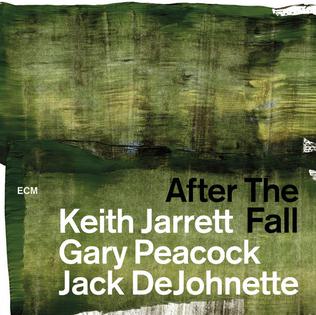
After the Fall (Keith Jarrett album cover).jpg

double-disc set

Title refers to the pianist's return to public performance after two years being sidelined by chronic fatigue syndrome.  live recording for a concert at New Jersey Cultural Center (?) in 1998, but not released until 2010 on CD.

SIDEMEN:   Gary Peacock, bass; Jack DeJohnnette, drums.


a superior performance overall, my reintroduction to Jarrett, et al.

No Jarrett originals in the set.  Of the twelve selections, six are popular standards; some of the rest-- e.g., "Scrapple from the Apple" "Doxy," or "Bouncin' with Bud"-- could be called "jazz standards."  Along with these come compositions new to my ears from Paul Desmond, Noel Coward, and John Coltrane.

Opening track, "The Masquerade Is Over" (Herb Magidson, Allie Wrubel) is a relatively-unknown tune that should be performed more often.  At over fifteen minutes, it is the longest track on the program.  A long, unaccompanied piano solo leads off; at about two and a half minutes, bass and drums join in and kick up the tempo.  The group recalls some of the great Bill Evans trios.

Jarrett is one of those pianists who "sing" off-mic to his own accompaniment.

Coward's "I'll See You Again" is taken at a swinging waltz tempo.
"Doxy" struts with aplomb, magnificent ensemble parts.
"One for Majid" 


Bird Songs.jpg

Up, Up and Away (Sonny Criss album).jpg
Inperson!.jpg


NEXT:  Yet More Moby Grape